


2026 Best Natural Gas Piston Compressor for Industrial Use?
A Natural Gas Piston Compressor is not chosen by headline capacity alone. The right machine must match gas composition, suction and discharge pressures, flow range, operating hours, and site conditions. A unit handling dry pipeline gas may perform differently when gas composition, temperature, or liquid carryover changes. Those details shape valve life, lubrication needs, cooling demand, and maintenance intervals.
W. Edwards Deming, a quality-management expert, offered a useful reminder: “In God we trust; all others must bring data.” For compressor selection, that means checking performance curves, power demand, materials, and service records—not relying on a brochure’s best-case figure. A buyer should also ask how the package behaves at part load, how quickly routine valve work can be completed, and whether trained service support is available. Small details matter. A noisy valve or rising discharge temperature can become a costly warning.
This guide compares leading 2026 options for industrial use, with attention to efficiency, durability, controls, and lifecycle support. The best choice depends on the duty. It may not be the most powerful model. Real operating data and a careful review of site requirements should guide the decision. Even then, estimates can miss. Confirm assumptions with the compressor manufacturer and a qualified application engineer before specifying equipment.
What Is a Natural Gas Piston Compressor?
2026 Best Natural Gas Piston Compressor for Industrial Use?
What Is a Natural Gas Piston Compressor?
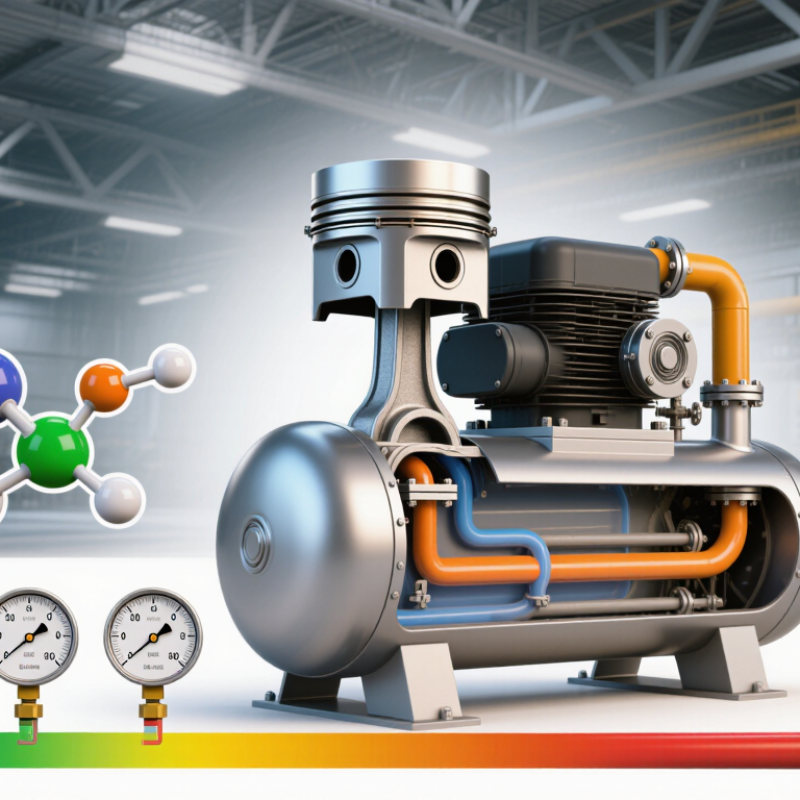
A natural gas piston compressor is a positive-displacement machine. A piston moves inside a cylinder, drawing in gas and compressing it as the cylinder volume decreases. Valves control the gas entering and leaving each cylinder. Multiple compression stages can raise pressure while intercoolers remove heat between stages.
These compressors serve gas gathering, processing, storage, and pipeline operations. Their suitability depends on the required flow, inlet pressure, discharge pressure, gas composition, and hours of operation. A unit sized for peak flow may run inefficiently at lower loads. That detail is easy to overlook. Operators should also review discharge temperature, vibration limits, lubrication needs, and maintenance access before choosing a machine. The IEA’s Global Methane Tracker 2024 estimates that fossil-fuel operations emitted about 120 million tonnes of methane in 2023. For compressor sites, that figure underscores why packing, seals, connections, and leak inspections deserve attention.
Tips: Match the compressor to real operating conditions, not only the nameplate capacity. Ask for performance data across expected load ranges. Check how the design handles gas impurities and changing suction pressure. Confirm inspection intervals and access to wear parts. Small leaks matter. Record vibration, temperature, and pressure trends; they can reveal developing problems, though readings alone do not explain every fault.
2026 Best Natural Gas Piston Compressor for Industrial Use? - What Is a Natural Gas Piston Compressor?
A natural gas piston compressor—also called a reciprocating compressor—uses a piston moving inside a cylinder to reduce gas volume and raise pressure. The most suitable configuration depends on the gas, required flow, suction and discharge pressures, operating schedule, and site conditions; there is no single best design for every industrial application.
| Selection dimension | Typical industrial considerations | What to check before selection |
|---|---|---|
| Compression principle | A crank-driven piston draws gas into a cylinder, compresses it, and discharges it through valves. Multiple cylinders or stages can be used. | Confirm the required pressure ratio, number of stages, cylinder arrangement, and operating speed with the compressor designer. |
| Common applications | Gas gathering, pipeline and storage service, fuel-gas boosting, gas processing, and industrial gas transfer. | Match the package to the actual duty cycle, required turndown, available utilities, and site operating conditions. |
| Capacity and flow | Capacity depends on cylinder displacement, speed, clearance, pressure ratio, gas properties, and the selected configuration. | Provide minimum, normal, and maximum flow in stated standard or actual volume units, with the reference temperature and pressure specified. |
| Pressure and staging | Higher overall pressure ratios are commonly handled with multiple compression stages and intercooling to manage discharge temperature and power demand. | Specify minimum and maximum suction pressure, target discharge pressure, pressure fluctuations, and allowable discharge temperature. |
| Gas composition | Molecular weight, compressibility, moisture, heavier hydrocarbons, carbon dioxide, and hydrogen sulfide can affect performance, materials, and sealing requirements. | Supply a representative gas analysis and identify contaminants, liquid carryover risks, and expected composition changes. |
| Lubrication and gas cleanliness | Cylinder designs may be lubricated or non-lubricated. The appropriate choice depends on gas service, contamination limits, materials, and maintenance requirements. | Establish acceptable oil carryover, lubrication arrangements, filtration, and any downstream gas-quality requirements. |
| Cooling and temperature control | Interstage cooling is often used in multistage service. Cooling also affects gas density, condensate formation, and overall package performance. | Check cooling-medium availability, ambient extremes, gas dew point, separator needs, and the consequences of condensate formation. |
| Load control and turndown | Capacity control can use methods such as clearance pockets, unloaders, speed control, or combinations, subject to the machine and application design. | Define the required flow range, control response, startup frequency, and expected time at reduced load. |
| Reliability and maintenance | Pistons, rings, valves, packing, bearings, and lubrication systems are typical inspection or maintenance items. Actual intervals depend on service and operating conditions. | Review service access, spare-parts availability, monitoring provisions, maintenance staffing, and the cost of planned downtime. |
| Safety and package design | A complete installation may require gas detection, pressure protection, ventilation, shutdown systems, pulsation control, and hazardous-area electrical equipment. | Confirm applicable local codes, site safety requirements, pressure-vessel requirements, noise limits, and any project-specific engineering standards. |
| Best-fit decision | A reciprocating compressor is often considered when the duty calls for positive-displacement compression, flexible pressure capability, or operation across changing process conditions. | Compare lifecycle cost, energy use, reliability, noise, footprint, and maintainability against other compressor types using the same defined duty. |
Values and performance are application-specific. Final sizing should be based on a documented gas composition and operating envelope, with review by a qualified compressor engineer.
