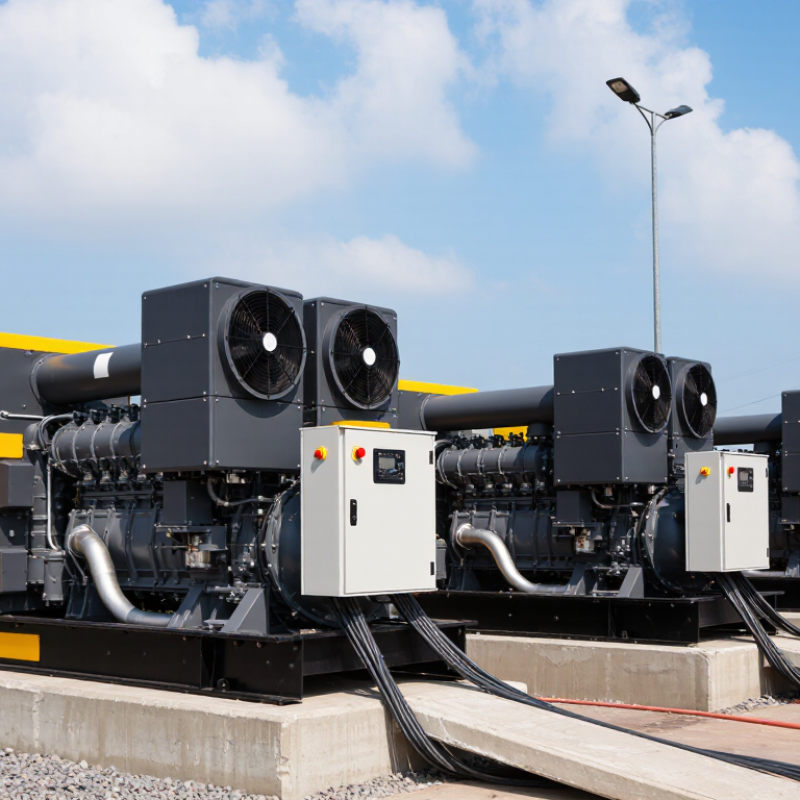
2026 Best Three Phase Diesel Generators for Global Buyers

Global power demand is becoming less predictable. The International Energy Agency’s Electricity 2025 report expects global electricity consumption to grow by more than 3% annually through 2027. Manufacturing plants, hospitals, construction sites, and data centers need dependable backup power when grids weaken or fail.

That is where a Three Phase Diesel Generator remains practical. It can support balanced industrial loads, long operating hours, and demanding motor-starting conditions. Yet fuel quality, ambient temperature, altitude, emissions rules, and service access can change real-world performance. A polished specification sheet is not enough.

The IEA’s Energy and AI report estimates that data-center electricity use could more than double by 2030. This trend increases pressure on standby systems and critical-power planning. Meanwhile, ISO 8528 provides a recognized framework for generator-set performance and rating classifications. Buyers should compare standby and prime-power ratings carefully. They should also check transient response, alternator design, controller functions, noise levels, and maintenance intervals.

This guide evaluates leading 2026 options for global buyers. It considers output range, fuel consumption, reliability, control systems, emissions compliance, and worldwide support. It also examines practical details, such as cold-start behavior at a remote site and service response after a long night.

No generator is perfect. That matters.

Market reports can describe growth, but they rarely reveal weak dealers or delayed spare parts. Therefore, the recommendations combine published specifications with application-focused judgment. Buyers should verify local certification, grid requirements, and total ownership costs before making a final decision.

2026 Best Three Phase Diesel Generators for Global Buyers

Define Three-Phase Output: 400/230 V at 50 Hz and 480/277 V at 60 Hz

A three-phase diesel generator rated 400/230 V at 50 Hz supplies about 400 volts between phases and 230 volts between one phase and neutral. This configuration is common across many 50 Hz electrical networks. The 480/277 V at 60 Hz rating works differently in value, but follows the same principle: 480 volts phase-to-phase and 277 volts phase-to-neutral. Check the nameplate carefully. Small voltage errors can damage connected equipment.

Three-phase output uses three alternating waveforms, spaced 120 degrees apart. Balanced loads allow the alternator to operate smoothly and reduce neutral current. However, real sites rarely stay perfectly balanced. Office lighting, pumps, chargers, and motors may load each phase unevenly. During commissioning, measure all phase voltages with a calibrated meter. Measure under load, not only at idle. That detail is often missed.

Frequency also matters. A 50 Hz motor connected to a 60 Hz supply may run at a different speed and produce unexpected heat. The reverse can also create performance problems. Confirm the generator frequency, engine speed, transfer switch setting, and load requirements together. Local electrical codes may permit different tolerances or earthing methods. I would not treat the two ratings as interchangeable. A practical selection sheet should list phase-to-phase voltage, phase-to-neutral voltage, frequency, rated current, and allowable imbalance. Leave room for doubt. Verify the site measurements before ordering.

Compare Prime and Standby Ratings Across 10–2,500 kVA Generator Classes

For global buyers, the difference between prime and standby ratings matters more than the nameplate size. A 10 kVA standby set may support emergency lighting, pumps, or small control systems. A 10 kVA prime set must tolerate regular operation and changing loads. At 2,500 kVA, the decision affects fuel systems, cooling, switchgear, and site planning.

Prime power suits remote mines, construction sites, rental fleets, and weak-grid locations. Its rating normally supports variable loads for extended periods, subject to the applicable standard and manufacturer limits.

Standby power is designed for utility outages, not daily production. Annual operating hours and average load restrictions can vary. Check the rating standard carefully.

Load-bank testing reveals problems that factory sheets may hide. Cold starts, voltage recovery, high ambient temperatures, altitude, and sudden motor loads deserve attention. A 500 kVA generator may appear adequate until pumps start together. It may then struggle. That mistake is common. For units above 1,000 kVA, buyers should review paralleling controls, medium-voltage options, fuel storage, and maintenance access. A 2,500 kVA installation also needs careful transport planning and stronger foundations. Local emissions, noise, electrical, and safety requirements must be confirmed before ordering. Documentation should include test records, protection settings, service intervals, and clear prime-to-standby derating data.

Apply ISO 8528 Standards and the 0.8 Power-Factor Sizing Rule

For global buyers, a three-phase diesel generator should be sized beyond the connected load. ISO 8528 provides a practical framework for generator performance, rating definitions, and operating conditions. Check the required duty, load profile, voltage, frequency, and allowable voltage recovery before comparing quotations. A standby unit is not automatically suitable for continuous operation.

The 0.8 power-factor rule remains a useful starting point. A 100 kW load requires about 125 kVA at 0.8 power factor. However, this calculation is incomplete. Motors, pumps, compressors, and transformers may demand high starting current. Variable-speed drives and data equipment can also create harmonic distortion. Size for starting performance, not only running watts. Add realistic headroom, but avoid excessive oversizing because lightly loaded diesel engines may suffer poor efficiency and wet stacking.

Site conditions matter. Altitude, ambient temperature, humidity, fuel quality, and long cable runs can reduce available output. An experienced engineer should review the worst operating case and confirm transient-response data. Factory tests are helpful, but commissioning under the actual load is more revealing. Perfect spreadsheets do not exist. An overlooked motor start or seasonal temperature change can expose a weak design. Require clear ISO 8528 performance details, protection settings, maintenance access, and documented test results before purchase.

Evaluate Tier 4 Final and EU Stage V Diesel Emissions Compliance

2026 Best Three Phase Diesel Generators for Global Buyers

For global buyers, emissions compliance should guide generator selection from the beginning. Tier 4 Final applies mainly to nonroad engines sold in the United States. EU Stage V governs comparable mobile and stationary equipment in European markets. Both standards demand very low particulate matter and nitrogen oxide emissions. Modern systems may use diesel particulate filters, selective catalytic reduction, exhaust gas recirculation, or combined controls. However, compliance depends on the complete engine and exhaust package. A clean-looking specification sheet is not enough.

Tips: Confirm the exact engine certification before ordering. Request test reports, conformity documents, and maintenance requirements. Check fuel sulfur limits in the operating country. High-sulfur fuel can damage after-treatment equipment. Also review the generator’s expected load profile, because long periods below 30% load may increase soot buildup. Small details matter.

Site conditions can change the practical result. Dust, heat, altitude, and unstable fuel quality may affect regeneration and sensor performance. I would not assume a Tier 4 Final unit automatically satisfies EU Stage V requirements. Certification labels, approval numbers, and installation conditions must match the destination market. Importers should verify noise, safety, and electrical rules separately. Regulations also change, and older advice can become unreliable. Experienced suppliers should provide traceable records, clear service intervals, and realistic operating limits.

2026 Best Three Phase Diesel Generators for Global Buyers - Evaluate Tier 4 Final and EU Stage V Diesel Emissions Compliance
Generator Configuration Typical Prime Power Range Three-Phase Electrical Format Primary Global Application Applicable Emissions Route Key Emissions Limits Required After-Treatment or Controls Buyer Verification Checklist
Compact industrial set 20–55 kW
25–69 kVA at 0.8 power factor
400/230 V, 50 Hz
or 480/277 V, 60 Hz
Power factor: 0.8 lagging
Small commercial buildings, telecom sites, workshops, agricultural facilities and emergency backup. EPA Tier 4 Final for U.S. nonroad use.
EU Stage V for European Union nonroad use.
EPA Tier 4 Final: NOx + NMHC up to 4.7 g/kWh, CO up to 5.0 g/kWh and PM up to 0.03 g/kWh, depending on engine power class.

EU Stage V: NOx + HC up to 4.7 g/kWh, CO up to 5.0 g/kWh and PM up to 0.015 g/kWh for the applicable power class.
Electronic fuel injection; exhaust gas recirculation may be used. Diesel oxidation catalyst and diesel particulate filter requirements depend on the certified engine family and market. Confirm the exact engine power class, certification label, rated-speed test cycle, particulate-matter limit and whether the installation is classified as stationary or nonroad mobile equipment.
Mid-size construction and rental set 56–129 kW
70–161 kVA at 0.8 power factor
400/230 V, 50 Hz
or 480/277 V, 60 Hz
Automatic voltage regulation recommended
Construction sites, rental fleets, temporary power, mining support and large commercial backup. EPA Tier 4 Final for U.S. equipment and nonroad applications.
EU Stage V for EU-market mobile machinery and generator installations where the regulation applies.
EPA Tier 4 Final limits vary by sub-band; the 56–130 kW class commonly uses a NOx + NMHC limit of 4.7 g/kWh and a PM limit of approximately 0.02 g/kWh.

EU Stage V generally applies NOx of 0.4 g/kWh, HC of 0.19 g/kWh, CO of 5.0 g/kWh and PM of 0.015 g/kWh in the relevant 56–130 kW class.
High-pressure common-rail injection, cooled EGR and oxidation catalyst may be combined with a diesel particulate filter. Selective catalytic reduction may be used on some engine families and duty cycles. Check regeneration strategy, minimum exhaust temperature, ash-service interval, urea/DEF requirement, cold-weather operation, telematics fault codes and the availability of compliant replacement filters.
Large industrial prime-power set 130–560 kW
163–700 kVA at 0.8 power factor
400 V, 50 Hz; 480 V, 60 Hz; or medium-voltage alternator packages for larger installations. Data centers, hospitals, factories, infrastructure projects, utilities and continuous-duty prime power. EPA Tier 4 Final for applicable U.S. nonroad engines.
EU Stage V for applicable EU nonroad engines.
EPA Tier 4 Final: NOx 0.4 g/kWh, NMHC 0.19 g/kWh, CO 3.5 g/kWh and PM 0.02 g/kWh for the 130–560 kW class.

EU Stage V: NOx 0.4 g/kWh, HC 0.19 g/kWh, CO 3.5 g/kWh and PM 0.015 g/kWh for the corresponding class; a particle-number limit of 1 × 10¹² particles/kWh applies where specified.
Diesel oxidation catalyst and diesel particulate filter are typical. Selective catalytic reduction may be required to achieve the applicable NOx target and may require diesel exhaust fluid. Require the complete engine certificate, conformity documentation, exhaust back-pressure limits, DEF quality specification, DPF regeneration plan, load-bank test results and site-specific ventilation calculations.
High-capacity data-center or utility set Above 560 kW
Above 700 kVA at 0.8 power factor
480 V or 600 V low voltage; medium-voltage output may be available for large projects. Parallel synchronization is normally required. Data centers, airports, large hospitals, industrial plants, utility support and multi-set microgrids. U.S. requirements depend on whether the equipment is a stationary reciprocating internal-combustion engine, an emergency generator or a non-emergency source.

EU compliance depends on the engine category, installation type, local permitting and whether EU Stage V is legally applicable.
Emissions limits are not determined by generator kVA alone. They depend on engine type, rated speed, duty classification, operating hours, fuel and the local permitting framework. Large-scale oxidation catalyst, particulate filtration and SCR may be used. Stationary installations can additionally require selective catalytic reduction, oxidation catalyst, formaldehyde controls or local air permits. Do not approve by “Tier 4” or “Stage V” wording alone. Confirm the site permit, emergency or prime classification, annual operating-hour limit, exhaust-stack design, acoustic limits and grid-parallel protection requirements.
50 Hz export configuration Any output class
Common ratings: 20–2,000 kVA
380/220 V or 400/230 V, 50 Hz
50 Hz alternator speed: typically 1,500 rpm for four-pole machines or 3,000 rpm for two-pole machines.
Europe, Africa, Asia-Pacific, the Middle East and other 50 Hz markets. EU Stage V may apply to the engine or machinery category; national electrical, safety and emissions rules must also be reviewed. For EU Stage V, verify the exact engine power band and the applicable NOx, HC, CO, PM and particle-number limits shown on the type-approval documentation. Automatic voltage regulator, electronic governor, compliant exhaust after-treatment and protection against overload, short circuit, reverse power and under-frequency. Confirm 50 Hz rating at the declared ambient conditions, voltage tolerance, frequency droop, harmonic distortion, step-load performance, phase sequence and local grid-connection requirements.
60 Hz export configuration Any output class
Common ratings: 25–2,000 kVA
480/277 V or 208/120 V, 60 Hz
60 Hz alternator speed: typically 1,800 rpm for four-pole machines or 3,600 rpm for two-pole machines.
North America, parts of Latin America, selected Middle Eastern markets and 60 Hz industrial projects. EPA Tier 4 Final may apply to U.S. nonroad engines. Stationary-source rules can be different from mobile or nonroad certification requirements. For the 130–560 kW EPA Tier 4 Final class, typical limits are NOx 0.4 g/kWh, NMHC 0.19 g/kWh, CO 3.5 g/kWh and PM 0.02 g/kWh. Depending on the certified engine, the system may include EGR, DOC, DPF and SCR with DEF. The equipment must be operated within the certified control strategy. Confirm EPA engine-family certification, 60 Hz rated load, emergency-generator rules, testing and maintenance obligations, exhaust routing, DEF logistics and local air-quality permits.
Prime-power and microgrid package 100–2,000 kVA per set
Multiple sets can be synchronized for higher capacity.
Three-phase, four-wire or three-wire output; automatic synchronizing, load sharing and power-management controls. Remote communities, industrial microgrids, renewable-energy hybrid systems, mines and utility-support applications. Emissions certification must be matched to the engine’s legal duty classification and the country where the set will operate. Use the engine certificate and local permit limits rather than relying only on the alternator rating. Emission values are measured in g/kWh and are not directly interchangeable with stack concentration values. Load management, automatic start/stop, spinning-reserve control and after-treatment thermal management are important for low-load and variable-load operation. Evaluate minimum stable load, wet-stacking risk, transient response, renewable ramping, battery coordination, black-start capability, synchronization protection and fuel-quality requirements.
Emergency standby package 25–2,500 kVA per set
Standby rating is not equivalent to prime rating.
Three-phase output with automatic transfer switch compatibility; 400/230 V at 50 Hz or 480/277 V at 60 Hz are common formats. Hospitals, commercial buildings, life-safety systems, data centers and critical infrastructure. Certification and operating-hour rules depend on jurisdiction. In the U.S., stationary emergency engines may be regulated differently from nonroad mobile engines. Do not assume that EPA Tier 4 Final or EU Stage V is automatically required or sufficient. Confirm the source category, emergency use definition, fuel type and local air permit. Automatic transfer controls, battery charger, jacket-water heater, exhaust silencer, ventilation system and periodic load testing are normally required. Verify standby and prime ratings, allowable annual operating hours, transfer time, fuel autonomy, starting reliability, black-start sequence, noise limits and maintenance access.

Important compliance note: EPA Tier 4 Final and EU Stage V are separate regulatory frameworks. A generator advertised as compliant with one standard should not be assumed to comply with the other.

How to compare emissions: Regulatory limits are normally expressed in grams per kilowatt-hour and are linked to the certified engine power band and test cycle. They should not be compared directly with stack concentration values such as ppm or mg/m³.

Procurement recommendation: Before purchase, request the engine type-approval certificate, conformity or EPA certification documentation, emissions-control description, rated-power declaration, duty classification and installation-specific permitting requirements.

Values shown are regulatory reference points and typical engineering configurations. The legally applicable limit must be confirmed against the exact engine family, model year, power class, duty category and destination country.

Select ATS, IP23 Alternators, Fuel Systems, and 24/7 Global Support

For global buyers, the 2026 best three phase diesel generators must handle unstable grids, harsh sites, and long operating hours. The IEA’s Electricity 2024 report estimates that data centers used about 415 TWh worldwide in 2024. Demand may exceed 945 TWh by 2030. Reliable backup power is no longer optional for many facilities.

Choose an automatic transfer switch with a verified switching sequence and adjustable time delays. ATS selection should match the load, fault current, and local electrical code. IP23 alternators provide protection against solid objects and vertically falling water. However, IP23 is not waterproof. Outdoor installations may need a weatherproof enclosure and controlled ventilation. Fuel systems deserve equal attention. Specify a day tank, filtration, leak detection, and enough autonomy for delivery delays. ISO 8528 performance ratings help compare generator behavior under changing loads. IEC 60034-1 supports alternator evaluation.

Tips: Ask for tested load-step results, not only rated kVA. Check cold-start performance at the actual site temperature. Request fuel-polishing guidance for stored diesel. Confirm spare-parts access and technician response in every operating region. The Uptime Institute’s 2024 Global Data Center Survey continues to identify power disruption as a major operational concern. Yet, remote monitoring alone cannot repair a failed starter. A practical support plan needs local skills, clear escalation, and realistic response times. Specifications look perfect on paper; field conditions rarely do.

Packaging machine ROI calculator

Need help figuring out if packaging automation is right for your business?


First, start with the numbers. Download our free packing machine ROI calculator to learn how long it will take for an investment in automation to pay for itself (and much more).


Free packaging automation ROI calculator