


2026 Top Coffee Packaging Bag Types for Global Buyers
The 2026 global coffee market will demand packaging that protects flavor, supports efficient logistics, and communicates responsible sourcing. Coffe Packaging Bags are no longer simple containers. They control oxygen, moisture, light, aroma release, and shelf presentation.
This guide examines flat-bottom bags, side-gusset bags, quad-seal bags, stand-up pouches, and small sachets. Each format offers different advantages. Flat-bottom bags stand firmly on retail shelves. Side-gusset bags use space efficiently during shipping. Quad-seal bags provide strong structure for larger coffee volumes. Stand-up pouches suit flexible retail displays and smaller product ranges. One-way degassing valves remain important for freshly roasted coffee, especially when carbon dioxide continues escaping after roasting.
Packaging engineer Robert Schinkel has said, “Coffee packaging is a silent quality-control system, not merely a printed wrapper.” His observation is practical. A beautiful bag cannot rescue weak seals or poor barrier performance. Buyers should compare oxygen transmission, moisture resistance, seal strength, valve reliability, filling speed, and recycling claims. Laboratory data matters more than attractive sustainability language.
Still, no universal “best” bag exists. A premium espresso line may need a rigid, high-barrier format. A subscription brand may prefer lighter pouches that reduce shipping volume. Some recyclable structures perform well, while others can complicate recycling systems. Compostable materials also require suitable collection conditions, which many regions do not provide. This is easy to overlook.
The sections ahead help global buyers connect bag design with roast profile, sales channel, transport distance, machinery, and local packaging requirements. Careful testing remains essential. Even experienced buyers can miss one weak seal.
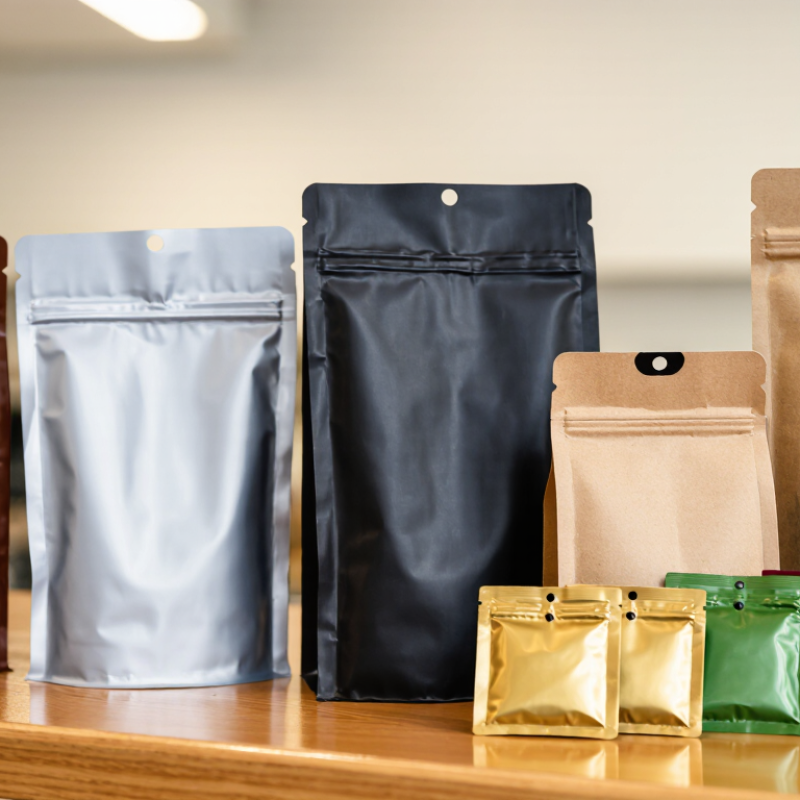
2026 Coffee Bag Types: 250 g, 500 g, 1 kg, and 2 kg Formats
Coffee packaging size should match buying habits, storage space, and shipping conditions.
The 250 g bag suits tasting programs, seasonal releases, and occasional home drinkers. It feels manageable on a kitchen shelf.
The 500 g format offers a practical balance for regular households. It reduces refill frequency without creating excessive exposure to oxygen.
The 1 kg bag fits cafés, offices, and serious home brewers. Its larger surface needs strong seals and reliable barrier protection.
The 2 kg format supports busy cafés and foodservice buyers with steady daily demand.
However, large bags may lose freshness after opening if staff handle them slowly. A perfect format does not exist.
Some buyers still choose 1 kg bags when two smaller bags would protect aroma better.
Tips: Compare bag size with weekly consumption. Check zipper strength, valve performance, and seal width during sampling. Confirm dimensions before approving cartons or pallet plans. Packaging teams should also verify food-contact requirements and labeling rules in each destination market. A simple drop test can reveal weak corners. It is easy to overlook this step. Consider recyclable structures where practical, but test their barrier performance first. Sustainability claims should match documented material data, not assumptions.
Barrier Films Target OTR Below 1 cc/m²/day for Coffee Freshness
In 2026, coffee packaging buyers are looking beyond attractive finishes. They are measuring oxygen protection. The International Coffee Organization’s 2024 Coffee Report estimated global coffee consumption at 177.9 million 60-kilogram bags in 2023/24. That scale makes freshness control commercially important, not decorative.
Barrier films targeting an oxygen transmission rate below 1 cc/m²/day can slow aroma loss and oxidation. Common structures include PET with polyethylene, metallized polyester, or aluminum foil laminates. Aluminum usually offers stronger protection, while metallized films can reduce material weight. Testing should follow recognized methods, such as ASTM F1927 or ISO 15106-3. Results need temperature and humidity conditions. Otherwise, comparisons become weak.
A low OTR film does not guarantee fresh coffee. Seal quality, zipper design, bag geometry, and residual oxygen also matter. Degassing valves create another variable. The Flexible Packaging Association has reported that flexible packaging remains valued for lightweighting and material efficiency, yet recyclability and multilayer separation remain practical concerns. That trade-off deserves scrutiny. A buyer should request the actual test report, not only a “high barrier” claim. Check OTR after forming, sealing, and transport simulation. Small defects can become large oxygen pathways. Freshness is a system result.
2026 Top Coffee Packaging Bag Types for Global Buyers - Barrier Films Target OTR Below 1 cc/m²/day for Coffee Freshness
| Bag Type | Typical Barrier Structure | Typical OTR (cc/m²/day) | Typical WVTR (g/m²/day) | Common Closure | Typical Capacity | Recommended Application | End-of-Life Consideration |
|---|---|---|---|---|---|---|---|
| Quad-Seal Bag | PET / aluminum foil / PE or PET / metallized PET / PE | <0.01–0.5 | <0.01–0.3 | One-way degassing valve; optional zipper | 250 g–2 kg | Whole beans and premium ground coffee requiring strong shelf stability | Multilayer foil structures provide high barrier but are generally difficult to mechanically recycle |
| Side-Gusset Bag | PET / aluminum foil / PE or PET / metallized PET / PE | <0.01–0.5 | <0.01–0.3 | Degassing valve; heat-sealed top or tin tie | 500 g–5 kg | Large-format coffee, foodservice packs, and traditional retail presentation | Flexible multilayer construction normally requires specialized collection and recycling systems |
| Flat-Bottom Bag | PET / aluminum foil / PE or high-barrier PET / PE | <0.01–0.5 | <0.01–0.3 | Degassing valve and resealable zipper | 250 g–1 kg | Premium retail coffee where shelf presence and stackability are important | High material complexity improves barrier performance but reduces conventional recyclability |
| Stand-Up Pouch | PET / metallized PET / PE or PET / EVOH / PE | 0.1–1.0 | 0.05–0.5 | Zipper, slider, or spout; optional degassing valve | 100 g–1 kg | Ground coffee, flavored coffee, and lightweight e-commerce formats | Mono-material PE options may support recycling where suitable collection infrastructure exists |
| Flat Sachet / Stick Pack | PET / aluminum foil / PE or PET / metallized PET / PE | <0.01–0.5 | <0.01–0.3 | Three-side or four-side heat seal | 2–30 g | Single-serve instant coffee, samples, and portion-controlled products | Small flexible packs are often not accepted in standard curbside recycling programs |
| Paper-Laminated Coffee Bag | Kraft paper / aluminum foil / PE or paper / metallized film / PE | <0.01–0.5 | <0.01–0.3 | Degassing valve, zipper, or tin tie | 250 g–1 kg | Paper-look retail packaging where high oxygen and moisture protection is required | Paper appearance does not make the laminate recyclable; foil and polymer layers must be considered |
| High-Barrier Mono-PE Pouch | PE / PE with high-barrier coating or EVOH layer | 0.2–1.0 | 0.05–0.5 | Zipper and optional one-way degassing valve | 250 g–1 kg | Brands prioritizing a recyclable-design pathway while maintaining coffee barrier performance | Potentially compatible with PE recycling streams, subject to local guidelines and package design |
| Paper-Based Fiber Barrier Bag | Paper / dispersion or bio-based barrier coating / sealant layer | 0.2–1.0* | 0.2–1.0* | Heat seal; zipper availability depends on construction | 250 g–500 g | Shorter distribution cycles and applications requiring a paper-forward appearance | Recyclability depends on coating weight, sealant type, fiber recovery, and local paper-mill requirements |
Technical Notes: OTR means oxygen transmission rate; WVTR means water vapor transmission rate. The ranges above are representative targets for finished flexible laminates measured under commonly used laboratory conditions, typically around 23°C. Actual results vary with film grade, humidity, thickness, seal quality, valve design, and test method.
* Fiber-based and EVOH-containing structures can be sensitive to humidity. For roasted coffee, specify the required OTR and WVTR at the intended storage temperature and relative humidity, and verify the complete package after converting and sealing. A one-way degassing valve is normally required for freshly roasted whole-bean coffee because carbon dioxide continues to be released after roasting.
Degassing Valves: 4–8 mm Options for Different Roast Profiles
Degassing valves help roasted coffee release carbon dioxide while limiting oxygen entry.
The need is measurable: the International Coffee Organization reported global coffee consumption at about 177 million 60-kilogram bags in 2023/24. Packaging errors therefore scale quickly. Valve diameter is only one control. Roast level, bean density, fill weight, storage temperature, and valve opening pressure also matter.
A 4 mm valve can suit lighter roasts with slower gas release and smaller retail packs.
A 6 mm option offers a practical middle range for many medium roasts.
Dark roasts often release gas faster, especially during the first several days, so an 8 mm valve may reduce pack swelling more effectively.
These ranges are useful starting points, not universal rules. The Specialty Coffee Association does not prescribe one diameter for every roast profile.
Real validation should include pressure checks, seal testing, and aging trials at expected shipping temperatures. The National Coffee Association’s 2024 trend report found that 67% of American adults drank coffee within the past day, reinforcing the need for reliable freshness protection across high-volume markets. Yet a larger valve cannot repair weak film or poor heat seals. That is an easy mistake. Buyers should test bags after roasting, at 24 hours, seven days, and fourteen days. Results may change with grind size and bean origin. A small pilot run is safer than selecting by diameter alone.
Sustainable Materials: 20–30% Recycled Content and Recyclability
2026 Top Coffee Packaging Bag Types for Global Buyers
Sustainable Materials: 20–30% Recycled Content and Recyclability
Coffee packaging is changing from appearance-driven design to measured material performance. Bags containing 20–30% recycled content can reduce virgin plastic use without immediately sacrificing strength. However, recycled layers may affect seal quality, odor control, or barrier consistency. I have seen small differences during filling trials. A stable bag still needs strong protection against oxygen, moisture, light, and aroma loss.
For global buyers, material claims should be supported by supplier specifications and test reports. Ask for the recycled content percentage, source, food-contact documentation, and recyclability conditions. A mono-material polyethylene or polypropylene structure may support recycling in suitable systems. Yet local collection facilities differ widely. A package labeled recyclable may not be accepted everywhere. This is where sustainability becomes less simple.
Tips: Test the finished bag, not only the film sample. Check drop resistance, seal strength, oxygen transmission, and shelf-life performance. Review the package after roasting, filling, transport, and storage. Ask whether inks, valves, zippers, and adhesives match the recycling pathway. Keep records for each production batch. A useful improvement may be reducing unnecessary layers, rather than adding recycled content alone. Mistakes happen, especially when regional recycling data is incomplete. Recheck the claim before printing thousands of bags.
Global Buyer Checklist: MOQ, Lead Time, Seal Strength, and Compliance
Global coffee demand makes packaging mistakes costly. The International Coffee Organization recorded 177.0 million 60-kilogram bags of consumption in 2023/24. Buyers should match the bag type to roast, shipping, and retail conditions.
Flat-bottom and quad-seal bags offer strong shelf presence and stable stacking. Side-gusset bags suit larger volumes. Stand-up pouches reduce material use, but their seals need careful testing. Aluminum-laminated structures provide excellent oxygen and light barriers. Mono-PE structures may support recyclability goals, though barrier performance can be weaker. Ask for oxygen transmission rate, water vapor transmission rate, and valve specifications. Do not accept “high barrier” without test results.
MOQ affects more than price. Request separate quantities for stock, printed, and custom-color bags. Confirm plate charges and reorder thresholds. A practical lead-time estimate is 15–25 days for stocked bags and 35–60 days for custom production. Treat these figures as planning ranges, not promises. ASTM F88/F88M seal-strength testing should support the supplier’s claims. Require production samples, burst checks, and filled-bag trials. A perfect laboratory seal can still fail on a humid loading dock.
Compliance documents should cover food-contact declarations, migration testing, ink suitability, and recycling claims. For European sales, review Regulation (EU) 2025/40 and its packaging requirements. For United States distribution, confirm applicable food-contact rules under 21 CFR. Smithers’ The Future of Global Flexible Packaging to 2029 highlights barrier films and recyclable structures as major development areas. Yet sustainability claims remain easy to exaggerate. Ask for evidence, and document every assumption before approving artwork.
2026 Top Coffee Packaging Bag Types for Global Buyers
Global Buyer Checklist: MOQ, Lead Time, Seal Strength, and Compliance
Planning benchmarks shown: typical commercial ranges for custom printed coffee bags, not supplier quotations. Final MOQ, lead time, and seal performance depend on material structure, printing method, order volume, testing requirements, and destination regulations.


