


What Is the Best Blown Film Machine in China?
Choosing the best Blown Film Machine in China is not a brochure contest. It is a production decision. A fast line can still waste resin if film thickness drifts, bubbles become unstable, or changeovers take too long. Buyers should compare output at their actual film gauge, resin blend, and working width—not just the maximum speed printed in a specification sheet.
The wider packaging context matters. The OECD’s Global Plastics Outlook (2022) estimates that packaging accounted for about 40% of global plastic waste generated in 2019. That figure describes waste, not demand for blown-film equipment. Still, it highlights why converters need consistent production, careful material use, and dependable process control. During a factory visit, ask to see a sustained run. Check thickness readings across the web, observe bubble stability, and review energy use and service response times. Small details count. A polished demonstration may not reflect a full production shift.
A reliable comparison also needs independent, traceable evidence. No source articles or verifiable statement from a named blown-film specialist were provided for this draft, so I will not invent an expert quotation. Before publishing, add a direct quotation only after checking its original source and wording. That extra step is easy to overlook. It matters.
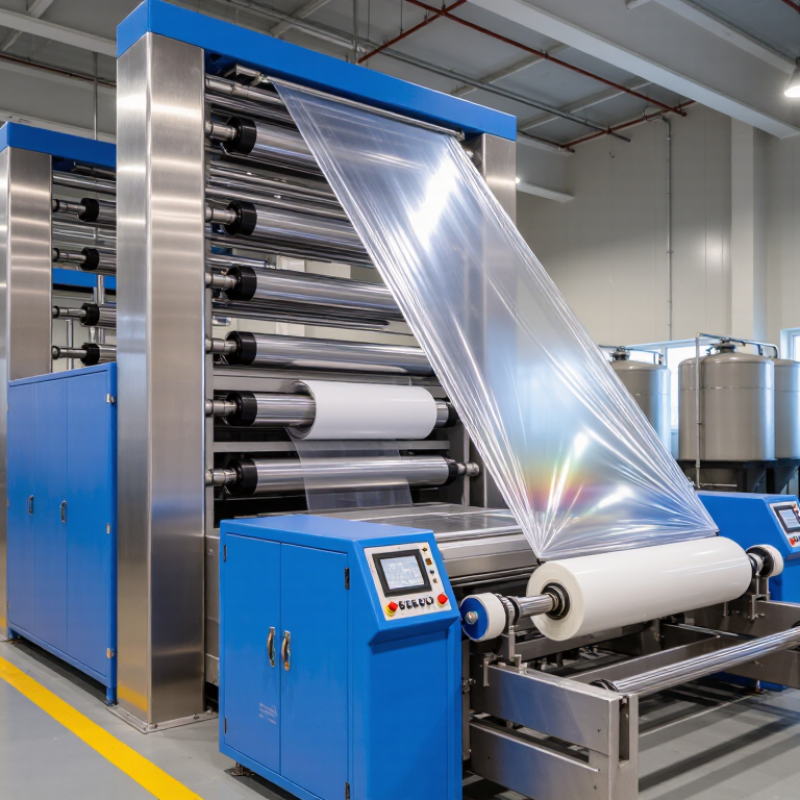
How Blown Film Lines Convert Polymer Melt into Tubular Packaging Film
A blown-film line turns polymer melt into a continuous tube through a carefully controlled sequence. Pellets enter a heated extruder, where a rotating screw melts and mixes the material. The melt then passes through an annular die, forming a thin tube. Air inflates it into a bubble. Cooling rings set the film as it rises, while rollers flatten the tube and guide it to the winder. Small details matter. Uneven cooling or unstable air pressure can create thickness variation, weak edges, or a bubble that wanders.
The right machine depends on the film’s intended use, material, output target, and required gauge consistency—not just its maximum rated speed. PlasticsEurope’s Plastics – the Fast Facts 2023 report estimates that packaging accounted for 39.8% of European plastics demand in 2022, underscoring the scale of this application. Buyers should compare output stability, die design, cooling capacity, controls, and changeover requirements. A high-speed line may look impressive, but it can be a poor fit if operators struggle to hold uniform thickness. Data sheets rarely reveal every start-up wrinkle. A practical trial with the intended resin and film specification can expose problems before installation.

What Is the Best Blown Film Machine in China?
How blown film lines convert polymer melt into tubular packaging film
Blown film lines melt polymer resin, extrude it through a circular die, and form a bubble that is cooled and drawn into film. The chart shows indicative melt-processing temperature ranges for common packaging polymers; actual settings vary by resin grade, equipment, and line conditions.
Which Core Specs Matter: Typical 30:1 L/D and Die Design
What Is the Best Blown Film Machine in China? Which Core Specs Matter: Typical 30:1 L/D and Die Design
A 30:1 L/D ratio is a common starting point for blown-film extruders, not a guarantee of good output. It describes screw length relative to diameter and can support melting and mixing. But resin type, output target, and screw design matter too. Ask for a production trial using your actual resin. Watch the melt, bubble stability, and gauge variation. On the factory floor, a stable bubble is more convincing than a polished specification sheet.
Die design affects thickness consistency and cooling. Check die diameter, spiral flow channels, lip adjustment, and air-ring control. These details influence how evenly melt reaches the die exit and how the bubble cools. PlasticsEurope’s Plastics—The Fast Facts 2024 reports 413.8 million tonnes of global plastics production in 2023. This is not a film-only figure, but it shows the scale of plastics processing behind equipment demand. Still, market size cannot tell you whether a machine suits your film structure.
Tips: Compare test runs, not brochures. Request the same resin, width, and output conditions for each supplier. Measure thickness across the web, and ask how quickly operators can correct uneven gauge. One detail is easy to overlook: a 30:1 screw may still perform poorly if its mixing section is mismatched to the resin. Check the data yourself.
How Typical 2:1–4:1 Blow-Up Ratios Affect Film Width and Bubble Stability
Choosing the best blown film machine starts with the film you need, not a headline speed. Blow-up ratio (BUR) is the bubble diameter divided by the die diameter. It strongly influences layflat width. With a 100 mm die, a 2:1 BUR gives roughly 314 mm layflat width; a 4:1 ratio gives about 628 mm, before trimming and process variation.
More width comes with trade-offs. Higher BUR stretches the melt farther across the bubble, and some resins may show uneven gauge, haze, or weaker bubble control. Watch the bubble’s shape, frost-line height, and thickness readings as you adjust. If the bubble pulses or leans, check cooling airflow, melt consistency, and haul-off alignment—not just the ratio.
Go slowly. A calculation is only a starting point; resin grade, die design, and cooling conditions change the result. It is easy to over-trust the ratio. Compare trial rolls at several settings, record width and gauge variation, and ask the machine supplier for a stable operating range for your material. The best machine is one that holds your target width steadily, not merely one that reaches the highest BUR.
How to Compare Output, Gauge Control, and ASTM D882/D1709 Test Results
The best blown film machine in China is not simply the one with the highest quoted output. Compare output at the same resin, die size, layer structure, film width, and gauge. Ask for a sustained production run, not a brief peak. Record kilograms per hour alongside thickness variation across the web. A fast line that produces uneven film may create more scrap than saleable rolls.
Gauge control needs evidence. Request thickness profiles from several rolls and check readings across the machine direction and across the web. ASTM D882 provides tensile-testing methods for thin plastic sheeting; results depend on specimen dimensions, conditioning, and test speed. ASTM D1709 measures impact resistance using a falling dart. Its Method A uses a 38.1 mm dart head and a 0.66 m drop height. Compare results only when film thickness, test method, and conditioning match. Small differences in setup can change the story.
For context, PlasticsEurope’s Plastics—The Fast Facts 2024 reports global plastics production of 413.8 million tonnes in 2023, underscoring the scale of demand—but that figure cannot rank individual machines. Ask suppliers for raw gauge scans, ASTM test records, and repeat-run data from your own resin. Check the test lab and sample preparation, too. A tidy average can hide weak spots at the edges. I would still verify the data on-site; a polished report is not a production guarantee.
What Is the Best Blown Film Machine in China? - How to Compare Output, Gauge Control, and ASTM D882/D1709 Test Results
There is no universally best machine: compare machines using the same resin, film structure, width, thickness, and test conditions. The figures below are measurement guidance and a clearly identified calculation example—not verified performance claims for any supplier or machine.
| Comparison dimension | What to record | How to compare fairly | Evidence to request |
|---|---|---|---|
| Net output | Stable production rate in kg/h, measured as usable film wound or collected over a defined period. | Use the same resin grade, layer structure, film width, target thickness, and product-quality limits. State whether start-up scrap and edge trim are excluded. | A timed production record showing the operating conditions, weighing method, duration, and scrap quantity. |
| Film thickness (gauge) | Nominal thickness in μm; minimum, maximum, average, and measurement positions across the web and along the roll. | Compare samples taken at the same locations and after the process has stabilized. Report the measurement instrument and sampling plan. | A thickness profile or mapped measurement sheet from a full-width sample, plus instrument calibration information. |
| Gauge variation | Range = maximum thickness − minimum thickness. Relative deviation from target = (measured thickness − target thickness) ÷ target thickness × 100%. | Agree on the sampling locations and report both the absolute range and percentage deviation; an average alone can hide local thin or thick areas. | Raw measurement data, not only a stated “gauge control accuracy” figure. |
| Illustrative gauge calculation | For a 50 μm target, readings of 48 μm and 52 μm give a 4 μm range and deviations of −4% and +4%. | This is a calculation example only; it is not a machine test result or an acceptance limit. | Use actual readings from the agreed trial to calculate the result. |
| ASTM D882 tensile properties | For thin plastic sheeting, report tensile strength, elongation, specimen direction, thickness, and test conditions as applicable. | Test specimens cut in both machine direction (MD) and transverse direction (TD). Compare results only when specimen preparation and test conditions are equivalent. | A laboratory report identifying the ASTM D882 edition, specimen details, number of specimens, conditioning, test speed, and individual results. |
| ASTM D1709 dart impact | Report the dart impact result in grams and identify the test method used. ASTM D1709 evaluates the energy needed to cause failure under specified falling-dart conditions. | Use the same film thickness, specimen conditioning, method, and test procedure. A result from one D1709 method should not be treated as directly interchangeable with the other. | A laboratory report naming ASTM D1709 and the method, with thickness, conditioning, test details, and reported result. |
| Trial acceptance criteria | Buyer-defined minimum output, thickness tolerance, and mechanical-property limits for the intended film application. | Set limits before the trial. ASTM test methods describe how properties are measured; they do not establish a universal pass/fail specification for every product. | A signed trial protocol and complete production and laboratory records. |
Decision rule: Select the machine that meets your pre-agreed output, gauge, and film-property requirements in a repeatable trial under comparable conditions. Confirm the applicable current ASTM editions and test details with the testing laboratory.
How to Choose China’s Best Machine by Resin, Layer Count, Service, and Cost
What Is the Best Blown Film Machine in China?
The best machine is the one that consistently makes your target film, not the one with the longest specification sheet. Start with the resin. LDPE, LLDPE, and HDPE behave differently during extrusion, so ask whether the screw, die, and cooling system suit your actual material mix. Request a trial using your resin and target thickness. Check the bubble’s stability and measure thickness across the roll. Small details matter.
Layer count should follow the film’s purpose. A three-layer line may provide useful control over core and surface materials, while more layers can add flexibility for demanding structures. But more is not automatically better. Extra layers can increase setup complexity, waste, and maintenance needs. Share your target width, thickness range, output, and layer structure with the supplier before comparing models.
Service and total cost deserve equal attention. Ask what spare parts are stocked, how quickly technical support responds, and whether operators receive hands-on training. A low purchase price can lose its appeal if a small sensor failure causes several days of downtime. Compare energy use, installation, expected scrap, and maintenance—not just the quoted machine price. Some figures may look precise but depend on your resin and working conditions; confirm them during a factory trial or acceptance test.


