


What Is the Best Child Proof Metal Box for Buyers in 2026?

Choosing the best Child Proof Metal Box in 2026 is not just a matter of thick steel or a satisfying click. Buyers need to assess the latch, hinge, opening sequence, finish, and consistency across production batches. A box can feel sturdy in the hand and still have a confusing mechanism. That detail matters.

America’s Poison Centers’ 2023 National Poison Data System annual report recorded about 2.1 million human exposure cases. The figure covers many substances and situations; it does not measure metal-box failures. Still, it shows why secure storage deserves careful attention. The U.S. Consumer Product Safety Commission’s child-resistant packaging protocol, 16 CFR § 1700.20, evaluates both children’s difficulty opening packages and adults’ ability to use them. A buyer should look for documented testing, not rely on “childproof” as a casual product claim.

Design scholar Don Norman offers a useful principle: “We must design for the way people behave, not for how we would like them to behave.” For box buyers, that means checking whether the opening steps are clear to intended adult users, while resisting casual access by young children. Ask suppliers for test records, material specifications, and sample units; inspect sharp edges, lid alignment, and repeated-use performance. Small checks. Easy to overlook. One limitation remains: a resistant box cannot replace responsible storage or supervision, and no short product description proves real-world performance. This guide compares practical features and evidence so buyers can make a more informed choice.
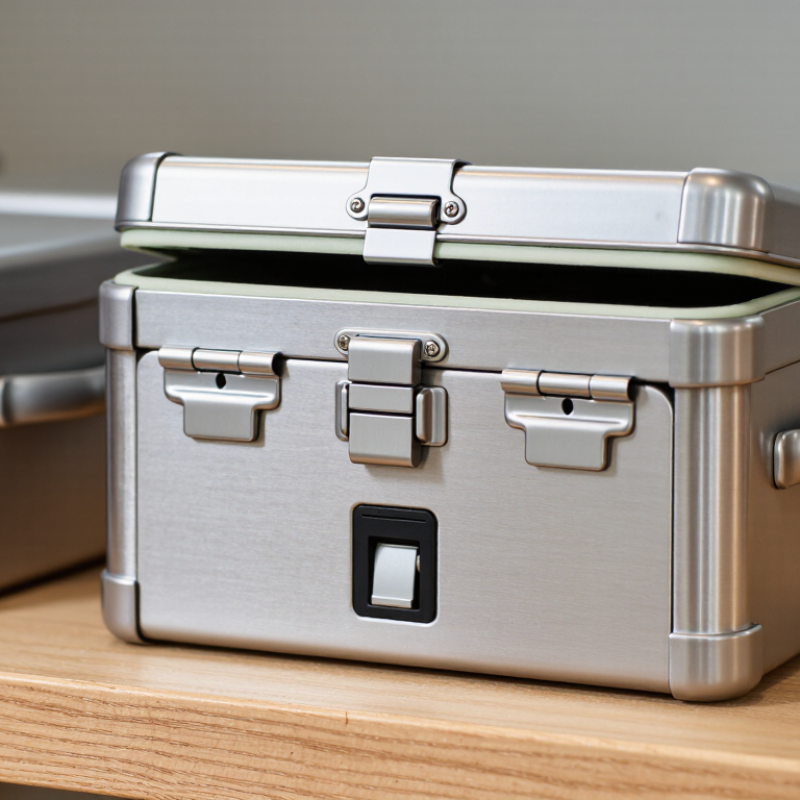
What Is the Best Child Proof Metal Box for Buyers in 2026?

What a Child-Resistant Metal Box Is and How It Works

A child-resistant metal box is designed to make opening harder for young children, not impossible. Its rigid shell may resist bending, while a concealed latch or two-step closure requires a specific sequence. A common design asks an adult to press one area while sliding or turning another. Small hands may struggle to coordinate those movements. That matters.

The mechanism should feel deliberate, not simply stiff. Check whether the lid closes fully, the latch engages, and the release works consistently. Rounded edges and a stable base are useful details, especially when the box sits on a shelf or table. Metal can feel sturdy, but construction quality varies. A tight-fitting lid alone does not prove that a box is child-resistant.

Follow the maker’s instructions and test the closure yourself before use. Keep the box out of reach, since no container replaces careful storage or supervision. Adults with limited hand strength may also find some multi-step latches difficult. That trade-off deserves attention. A design that is secure but confusing can lead to improper closing, so look for clear instructions and a mechanism you can operate reliably.

Key Locking Mechanisms and Child-Resistance Features

A child-resistant metal box depends on more than a sturdy shell. The lock should resist casual opening while remaining manageable for an authorized adult. A keyed cam lock is common: turning the key moves a metal tongue behind the frame. Check that the tongue engages fully and cannot be pushed aside through a loose lid. That matters.

Some boxes use pin-tumbler cylinders, while others use simpler wafer-style locks. Either can work, but build quality and fit are important. Look for tight hinges, reinforced corners, and a lid that does not flex when pressed. A small gap may let curious fingers explore the latch. No lock is perfect. Child resistance is not the same as childproofing.

Key control is part of the design. Keep spare keys secured separately, and avoid leaving one in a nearby drawer. Test the lock after repeated use; keys should turn smoothly, without sticking or excessive force. If the box is difficult for an adult to operate, it may encourage unsafe workarounds. I would also check whether the manufacturer explains the lock type and care requirements clearly. That detail is easy to overlook, and metal alone offers no meaningful protection if the locking mechanism is weak.

Metal Types, Construction, and Box Size

For a child-resistant metal box, compare the metal, seams, hinge, and latch as one system. Steel usually feels rigid and resists dents, but exposed edges and scratched coatings can rust. Aluminum is lighter and easier to carry. The Aluminum Association’s Aluminum Standards and Data lists 5052-H32 sheet with a minimum yield strength near 193 MPa; actual performance depends on thickness and temper. Material alone proves little. A thin lid can still flex.

Look closely at the build. A folded or continuously welded seam leaves fewer gaps than a loosely joined rim. Check whether the hinge pins stay covered and whether the latch needs a deliberate sequence, not just a press. A confident click is not proof of child resistance. The U.S. CPSC’s small-parts test cylinder measures about 1.25 inches across and 2.25 inches deep; it is a hazard-screening tool, not a box-size recommendation. Leave room for contents without forcing the lid upward, and measure the usable interior, not the outside. I would also test the latch repeatedly. Wear changes the feel, and that detail is easy to miss.

How to Compare Boxes for Different Buyer Needs

What Is the Best Child Proof Metal Box for Buyers in 2026?

How to Compare Boxes for Different Buyer Needs

The best choice depends on who will use the box and where it will sit. A busy kitchen may need a compact model with a firm latch and smooth edges. A workshop may call for thicker metal, reinforced hinges, and a finish that resists damp air. Measure the items and shelf space before comparing listings. Product photos can hide awkward proportions. Child-resistant does not mean childproof, so consider the box one part of a wider safety plan.

Compare the opening mechanism with the intended adult users. A complicated latch may slow a curious child, but it can also frustrate someone with limited hand strength. Check stated dimensions, material thickness, hinge construction, and cleaning instructions. If the box will be moved often, inspect its weight and handle design. For fixed storage, look for secure mounting options. Ask the seller about testing or applicable safety documentation rather than relying on a vague “secure” claim. No box is perfect. That trade-off is easy to overlook.

Tips: Test the latch several times before regular use. Keep keys or access codes out of children’s reach, and inspect hinges for looseness. Recheck the fit after moving the box.

What Is the Best Child-Resistant Metal Box for Buyers in 2026?

Compare common box designs by buyer priorities. Scores indicate typical design fit on a 1–5 scale; they are comparative estimates, not product test results or proof of child-resistant compliance.

How to use this chart: A compact hinged tin may suit portable, simple storage; a gasketed metal case may be a better fit where moisture resistance matters; and a lockable steel box or cabinet may suit buyers prioritizing access control. Features vary by model. For child-resistant use, verify the exact product’s applicable testing and certification rather than relying on its material or lock style alone.

Safety Standards, Testing, and Responsible Use in 2026

What Is the Best Child Proof Metal Box for Buyers in 2026?

In 2026, a dependable child-resistant metal box should come with clear, verifiable safety information. Standards vary by product type and market, so ask which requirements apply and request current test documentation. A credible report should identify the tested model, the test method, and the laboratory. Check that the box you receive matches those details. A certificate alone may not explain how the latch performed after repeated use. Look for smooth edges, a stable hinge, and a closure adults can operate consistently. Small details matter.

Tips: Try the latch several times before use, and inspect it for sticking or loose parts. Keep the box secured and out of children’s reach; child-resistant does not mean childproof. Follow the maker’s care instructions, and stop using the box if its closure becomes damaged. Keep contents and access appropriate for your household, too.

Responsible use continues after purchase. Store the box in a dry place, away from heat and damp surfaces that could affect its finish or mechanism. Explain to caregivers how it opens and where it is kept. Do not rely on a lock as a substitute for supervision. I would also recheck the latch now and then, even when everything seems fine. That extra check is easy to overlook.

What Is the Best Child Proof Metal Box for Buyers in 2026? - Safety Standards, Testing, and Responsible Use in 2026
Buyer consideration Evidence-based benchmark What to check before buying Responsible-use note
Meaning of “child-resistant” Child-resistant packaging is designed to be significantly difficult for young children to open within a reasonable time, while remaining usable by adults. It is not completely child-proof. Look for documentation that applies to the exact box, closure, liner, and configuration—not just a claim about the metal material. Keep the box out of children’s sight and reach even when it has a child-resistant closure.
U.S. child-panel test Under the U.S. protocol in 16 CFR § 1700.20, the child test uses children aged 42–51 months. In the first 5-minute phase, at least 80% must be unable to open the package; after a demonstration, at least 85% must be unable to open it during the subsequent test phase. Ask for the test report or compliance documentation and confirm the tested package matches the item being sold. Test results apply to a defined package design and test protocol; they do not guarantee that every child will be unable to open it.
U.S. adult-use test The U.S. protocol also evaluates adults aged 50–70. The required adult-use effectiveness is at least 90% able to open and properly resecure the package under the prescribed test. Check that the closure can be operated and resecured as instructed, including by intended adult users. Always close and resecure the box immediately after use. Do not leave it partially closed.
Metal construction Steel, tinplate, and aluminum describe materials; the metal itself does not establish child resistance. Performance depends on the complete package and its opening mechanism. Inspect for sharp edges, pinch points, corrosion protection, sturdy hinges, and a closure that stays aligned after repeated use. Discard or repair a box with a damaged latch, distorted lid, or sharp exposed edge; damage may affect both safety and operation.
Closure usability Child-resistant designs commonly require a specific combination of actions, but a particular mechanism is not proof of compliance by itself. Check whether instructions are clear, whether the mechanism works consistently, and whether the intended adult can open and resecure it comfortably. Do not modify, remove, or disable the closure. Store the box locked or closed whenever it is not in use.
Testing and documentation In the United States, the Poison Prevention Packaging Act regulations and test procedures are set out in 16 CFR Part 1700. Requirements can vary by product and jurisdiction. Request current, product-specific test or compliance records. Verify the applicable rules for the contents and the market where the box will be used. A generic certificate, a material specification, or a seller’s unverified statement is not a substitute for relevant package-level evidence.
Best-fit selection for 2026 No single metal box can be identified as “best” without verified test results, intended contents, user needs, and destination-market requirements. Prioritize documented package-level performance, reliable reclosure, durable construction, clear instructions, and suitability for the intended contents. Follow the product’s storage instructions and applicable local requirements; child-resistant packaging is one safety measure, not a replacement for supervision.
Packaging machine ROI calculator

Need help figuring out if packaging automation is right for your business?


First, start with the numbers. Download our free packing machine ROI calculator to learn how long it will take for an investment in automation to pay for itself (and much more).


Free packaging automation ROI calculator