How to Choose Pallet Flow Racking for Your Warehouse?
Choosing Pallet Flow Racking is not simply a matter of buying more storage positions. It requires a clear understanding of products, pallet movement, order frequency, and workplace conditions. In a busy warehouse, one poorly selected lane can create congestion, uneven stock rotation, or difficult replenishment. The mistake may remain hidden until peak demand arrives.
Inventory management expert David J. Piasecki states, “The goal of inventory management is to have the right product, in the right place, at the right time, and in the right quantity.” This principle strongly supports the careful use of Pallet Flow Racking. The system can encourage first-in, first-out movement, reduce forklift travel, and keep fast-moving pallets accessible. However, it is not automatically the best solution for every operation.
Real decisions begin with physical details. Consider pallet weight, dimensions, load stability, and product temperature requirements. Measure aisle widths and ceiling clearance. Watch how pallets actually enter and leave the warehouse. A drawing may look efficient. The floor may disagree.
Do not overlook the small parts.
Brake rollers, guide rails, lane depth, and rack protection can affect daily performance. Operators also need safe loading procedures and regular inspections. Yet even experienced planners can misjudge demand patterns or future product changes. That uncertainty deserves attention. This guide explains how to compare pallet flow designs, calculate practical capacity, assess safety factors, and select equipment that fits your warehouse rather than forcing the warehouse to fit the equipment.
Understanding Pallet Flow Racking and Its Warehouse Applications
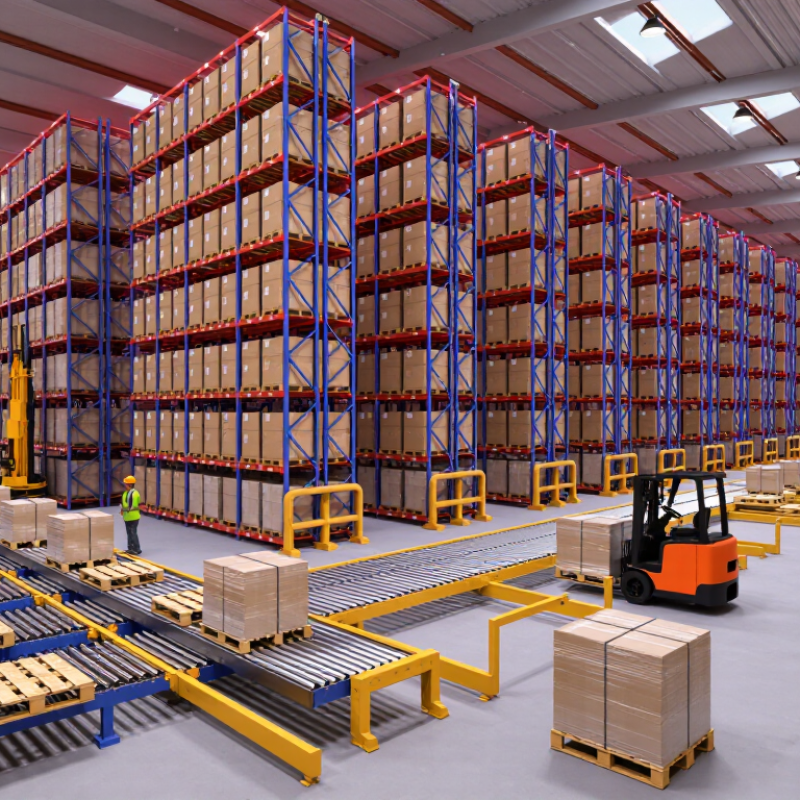
Pallet flow racking uses inclined roller lanes to move pallets by gravity. A forklift loads products from the rear, while pallets travel toward the picking face. This design supports FIFO inventory control, which is useful for food, beverages, medicine, and other dated goods. It also reduces travel distance in busy warehouses. Keep it simple.
The best application depends on product turnover, pallet dimensions, load weight, and available aisle space. Fast-moving products benefit from dedicated flow lanes because operators can pick from the front continuously. Slow-moving stock may need a different system, since unused lanes can waste valuable space. A site survey should check floor levelness, ceiling height, temperature, and forklift access. Small errors matter. An uneven floor, damaged pallet, or incorrect roller setting can interrupt movement. In practice, the first layout is rarely perfect, so trial loading and measured adjustments are sensible.
Tips: Confirm the heaviest pallet before selecting lane equipment. Use compatible pallets with strong, undamaged bases. Ask for brake rollers when loads need controlled speed. Install clear lane labels and inspect rollers regularly. Keep loading and picking zones separate where possible. Record jams, damaged pallets, and replenishment time during the first few weeks. These observations often reveal problems that drawings miss. A qualified storage professional should verify structural capacity, protection measures, and installation details before use.
Assessing Storage Requirements, Pallet Types, and Available Space
Choosing pallet flow racking starts with a clear picture of your storage requirements. Review inventory levels, daily pallet movements, and product rotation over several weeks. Fast-moving goods usually benefit from dedicated lanes and direct replenishment access. Slow-moving stock may not justify deep flow channels. Measure peak demand, not only average demand.
Pallet type matters just as much. Standard wooden pallets can vary in board spacing, width, and stiffness. Plastic pallets may behave differently on rollers. Check every pallet’s length, width, height, and loaded weight before selecting the track system. A damaged pallet can stop a lane. Test representative pallets with real loads whenever possible. This practical step often reveals problems that drawings miss.
Available space controls the final layout. Measure clear height, column positions, doorways, sprinkler equipment, and floor conditions. Allow room for loading, unloading, inspections, and safe equipment movement. Narrow lanes may increase capacity, but they can slow operations or restrict handling equipment. I have seen plans that looked efficient until operators needed to turn with a full pallet. That mistake is expensive. Leave enough clearance for routine work, not just the rack itself. Confirm load ratings with a qualified storage-system professional, and check local safety requirements before installation. A small pilot lane can expose poor pallet fit, awkward replenishment, or unexpected congestion before the entire warehouse is committed.
Evaluating Rack Capacity, Safety Features, and Operating Conditions
How to Choose Pallet Flow Racking for Your Warehouse?
Pallet flow racking should match real loads, not optimistic estimates. Record each pallet’s weight, dimensions, entry speed, and storage height. Then calculate beam, roller, frame, and floor loads separately. ANSI MH16.1 guidance requires rack design to consider structural capacity, seismic conditions, and impact forces. A practical audit also checks the heaviest pallet, not only the average one. One overloaded lane can distort rollers and create dangerous movement.
Safety needs physical controls and disciplined operation. Use pallet stops, back guards, guide rails, and load-position indicators where suitable. Add speed controls when forklifts approach the loading face. The U.S. Bureau of Labor Statistics reported 4.8 recordable cases per 100 full-time workers in transportation and warehousing in 2023, compared with 2.4 across private industry. That gap deserves attention. OSHA warehouse guidance also stresses aisle clearance, rack inspection, and forklift training.
Operating conditions can change the answer. Cold rooms may stiffen lubricants and affect roller performance. Dust, moisture, and uneven floors can increase resistance. Fire protection must be reviewed with the building’s sprinkler design. Check stock rotation, pallet quality, and replenishment frequency before selecting lane depth. Older pallets often have broken boards. A neat calculation can still fail. Leave inspection access, define damaged-rack procedures, and record monthly observations. Independent engineering review is wise when capacities, seismic risks, or unusual pallet shapes remain uncertain.
Comparing Pallet Flow Rack Designs, Components, and Costs
Choosing pallet flow racking starts with product movement, not the lowest quotation. A FIFO design uses inclined rollers, allowing older pallets to exit first. A LIFO design uses lanes with entry and retrieval from the same side. It usually costs less, but inventory rotation becomes weaker. For mixed products, adjustable lane widths and braking rollers matter. For uniform, high-volume cartons, simpler wheel-bed lanes may provide better value. The MHI 2024 Annual Industry Report reported that 55% of supply chain professionals planned higher technology investment. That supports reviewing flow racks alongside warehouse software, scanning, and labor planning.
The main components are uprights, beams, guide rails, rollers, entry separators, brakes, and pallet stops. Roller pitch must match pallet quality and load weight. A damaged pallet can create resistance quickly. ANSI MH16.1 guidance should inform rack design, anchoring, and load calculations. Budgetary estimates often place pallet flow systems around 250 to 600 dollars per pallet position, before unusual building work, installation, or fire protection changes. Conventional selective rack may cost less, while push-back systems can reduce aisle space but add cart and inspection requirements. These figures are planning ranges, not purchase prices. My first estimate was too optimistic after adding guards, controls, and field leveling. That mistake is common. Request itemized quotations, test one loaded lane, and measure extraction force during a normal shift. Availability looks efficient on paper. Poor pallets can disagree.
How to Choose Pallet Flow Racking for Your Warehouse? - Comparing Pallet Flow Rack Designs, Components, and Costs
| Rack Design | Operating Principle | Best-Fit Applications | Typical Pallet Load | Recommended Lane Depth | Stock Rotation | Relative Throughput | Estimated Installed Cost* |
| Standard Pallet Flow Rack | Gravity rollers move pallets from the loading side to the picking side. | High-volume warehouses handling several pallets of the same SKU. | Up to approximately 2,500 lb per pallet, subject to engineering approval. | 3–10 pallets | FIFO | High | $180–$350 per pallet position |
| Carton-Flow-Assisted Pallet Flow | Pallet lanes use rollers, while cartons or cases are picked from flow shelves at the front. | Mixed pallet-and-case picking operations with frequent order assembly. | Typically 1,000–2,500 lb per pallet position. | 2–6 pallets | FIFO for pallets; first-in-first-out for cartons when replenished correctly. | Medium to high | $220–$450 per pallet position |
| Push-Back Rack with Roller Carts | Each new pallet pushes the previous pallet deeper into the lane. | High-density storage where LIFO access is acceptable. | Commonly 2,000–3,000 lb per pallet, depending on cart and frame design. | 2–6 pallets | LIFO | Medium | $160–$320 per pallet position |
| Pallet Flow with Brake Rollers | Controlled-resistance rollers regulate pallet speed on sloped lanes. | Heavy or unstable loads and operations requiring smoother pallet movement. | Approximately 2,000–3,000 lb per pallet, after load testing. | 3–10 pallets | FIFO | High and controlled | $210–$420 per pallet position |
| Powered Pallet Flow | Motor-driven rollers transport pallets through deep lanes with automated controls. | Large distribution centers with high movement rates and limited operator travel. | Often 2,000–3,000 lb per pallet; final capacity is application-specific. | 6–20 pallets | FIFO or LIFO, depending on the system layout. | Very high | $450–$900 per pallet position |
Key Components to Specify
Upright frames, load beams, roller tracks, brake rollers, guide rails, pallet stops, lane dividers, backstops, safety barriers, and end-of-aisle protection.
Selection Priorities
Confirm pallet dimensions, actual load weight, pallet quality, SKU velocity, required stock rotation, lane depth, forklift type, ceiling height, and available aisle space.
Safety and Compliance
Rack capacity must be verified by a qualified engineer. Include pallet-flow speed control, positive pallet stops, load restraints, impact protection, inspection procedures, and applicable local building and fire-code requirements.
*Estimated installed costs are indicative 2025–2026 U.S. market ranges in USD per pallet position. They may vary with rack height, lane depth, load capacity, seismic requirements, installation conditions, automation, freight, and local labor rates. Costs exclude building modifications, forklifts, warehouse-management software, and taxes.
Selecting and Planning the Right Pallet Flow Racking System
How to Choose Pallet Flow Racking for Your Warehouse?
Selecting and Planning the Right Pallet Flow Racking System
Pallet flow racking should begin with product movement, not equipment dimensions. Map daily receipts, dispatches, pallet weights, and storage temperatures. The MHI 2024 Annual Industry Report found that 55% of surveyed supply-chain professionals use cloud computing. Connect inventory data with rack planning where possible. This helps reveal fast-moving stock and uneven replenishment patterns. Aisle width must support the actual handling equipment. Do not copy a nearby warehouse layout.
Plan each lane around pallet quality, load stability, and rotation requirements. Flow lanes can support first-in, first-out handling when pallets enter from one side and exit from another. However, damaged pallets may stop rollers or create unsafe gaps. Specify pallet dimensions, bottom-board design, and maximum loads before selecting components. The Rack Manufacturers Institute stresses engineering-based rack design under applicable ANSI standards. Confirm the floor slab, seismic conditions, guardrails, and clearances with qualified professionals.
Leave room for inspection.
A practical design should also include brakes, speed controllers, and lane separators where needed. Test representative pallets during commissioning, including heavy and lightly wrapped loads. This step is often skipped. It should not be. Warehouse teams can expose friction, noise, and awkward replenishment movements that drawings miss. Review seasonal volume too. A system sized only for average demand may become congested during peak weeks. Document inspection routines, training, and load limits clearly before daily operation begins.