10 Tips for Choosing the Best 22kW Car Charger
Choosing a 22kw Car Charger is not just about buying the highest number on the product label. The right unit must suit your vehicle’s onboard charging limit, your home’s electrical supply, and your daily parking routine. A 22kW charger can only deliver its full rated power when the car and installation can support it. Check the details. A capable charger paired with a lower-capacity vehicle may still work well, but it will not charge that car at 22kW.
EV charging educator Tom Moloughney’s charger testing offers a useful principle, paraphrased here: “Match the charger to the car, electrical supply, and daily routine.” That means looking beyond app features and sleek housings. Check connector compatibility, cable reach, weather protection, load management, warranty terms, and whether the unit has clear installation guidance. Picture the actual setup: a cable stretching across a narrow garage, a charger exposed to afternoon rain, or two household appliances running during a charging session. Small details matter. This guide’s ten tips will help compare those practical trade-offs and identify questions to ask a qualified installer. One limitation is easy to overlook: product specifications do not guarantee real-world charging speed. Supply capacity, installation choices, and vehicle settings all affect results. Even careful buyers can miss a detail. That is worth admitting. A little skepticism can prevent an expensive mismatch.
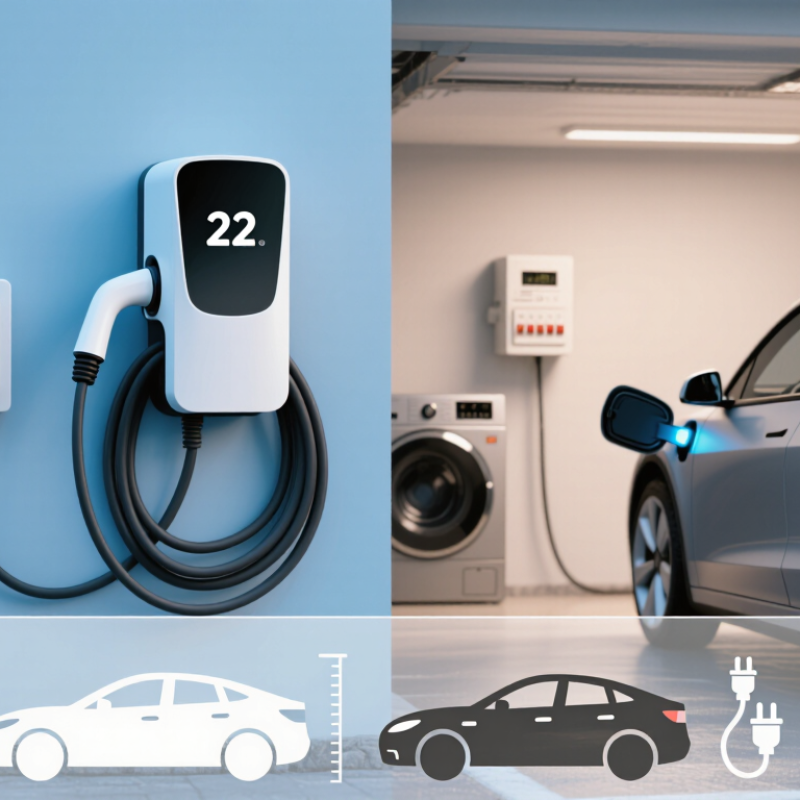
Establish the 22 kW Baseline: 400 V Three-Phase Power at 32 A
A 22 kW AC charger is built around a specific electrical baseline: 400 V three-phase power, with 32 A available on each phase. The calculation is straightforward: √3 × 400 × 32 is about 22.2 kW. Three phases matter. A single-phase connection will not deliver the same output, even if its current rating looks impressive.
Treat 22 kW as a potential rate, not a promise. The vehicle’s onboard charger must accept three-phase AC at that power; many cars accept less. Check its specifications before choosing equipment. Also ask an electrician to verify the supply, wiring, protective devices, and available capacity. A display showing 400 V does not prove that a site can sustain 32 A per phase while other loads are running.
Look beyond the headline rating. A long cable run, warm conditions, or household demand may affect the practical setup, so load management can help prevent the charger from exceeding the site’s capacity. Confirm that the cable and connectors suit the intended current, too. Small detail, big difference. One useful question for an installer is whether the full three-phase current is available continuously, not merely during a quick test. I’d check that twice; the specification sheet alone can leave an awkward gap between rated power and everyday charging.
Check Vehicle Compatibility: The Onboard Charger Sets the AC Charging Limit
A 22kW AC charger can only deliver what your car’s onboard charger accepts. That component converts incoming AC power into the DC power stored in the battery. For example, a car rated for 11kW AC will generally peak near 11kW, even when connected to a 22kW unit. The larger number on the charger is not a promise of faster charging. It is easy to overlook this detail.
Check the vehicle manual or technical specifications for its maximum AC charging rate. Confirm the supported supply, such as single-phase or three-phase power, too. A matching plug does not guarantee matching charging speed. Tip: Compare the car’s AC limit with the charger’s output before buying. If the car accepts only 7kW, a 22kW charger may offer little speed benefit at home.
Real charging power can also fall below the stated limit. Household load sharing, a restricted electrical supply, or a cold battery may reduce the rate. Look at the vehicle display during a normal charge, and compare it with the manual’s rating. The figures may not line up perfectly. That is worth checking, rather than assuming the charger is faulty.
Match the Connector and Standard: Type 2 and IEC 62196
For a 22 kW AC charger, check that your car has a Type 2 inlet and supports three-phase charging. Type 2 is the connector style commonly specified under IEC 62196-2. The standard helps confirm physical compatibility, but it does not guarantee a 22 kW charging rate. Your car’s onboard charger sets an important limit. Check the vehicle manual and charger specifications before buying.
Tip: Match the connector at both ends. If the charger has a socket, you may need a separate Type 2 cable. Confirm its current rating supports the charger’s output. Check the inlet first. A single-phase car may charge much more slowly, even when connected to a 22 kW unit.
Do not rely on connector shape alone. Look for clear references to Type 2 and IEC 62196-2 in the product documentation, then verify the electrical setup with a qualified installer. Small detail, big difference. I’d also check cable length against your parking position; a short cable can turn a compatible setup into an awkward one. It is easy to overlook.
Verify Electrical Protection: IEC 60364-7-722 and 6 mA DC Fault Detection
A 22 kW charger typically draws about 32 A per phase on a three-phase supply. That makes correctly matched protection essential, not optional. IEC 60364-7-722 calls for an individual residual-current device (RCD) for each AC charging point, with rated residual operating current no greater than 30 mA. It also requires protection against smooth DC fault currents. Where a Type A or Type F RCD is used, a 6 mA DC residual-current detection device can provide that protection, in line with IEC 62955. Check the charger’s built-in detection and installation documents; don’t assume a feature from a product label alone.
Small details matter. A missed protective-earth connection or unsuitable upstream RCD can undermine an otherwise tidy installation.
The International Energy Agency’s Global EV Outlook 2024 reports that public charging points grew by over 40% in 2023, exceeding four million worldwide.
More charging equipment means more installations to verify carefully. Ask a qualified electrician to confirm the earthing arrangement, RCD type, 6 mA DC detection, and local adoption of IEC requirements. Keep the test results. A neat cable run looks reassuring, but it proves nothing about fault protection. Even experienced installers can overlook a detail; independent verification is worth the extra check.
Assess Installation and Features: Load Balancing for a 32 A Charging Load
A 22kW charger usually draws up to 32 A per phase on a suitable three-phase supply. That figure deserves a careful check. A home’s available capacity may be lower when an oven, heat pump, or water heater is running. Load balancing measures the property’s demand and adjusts charging current to reduce the risk of overloading the supply.
Ask a qualified installer to check the incoming supply, phase arrangement, cable route, and protective equipment. The charger’s sensor should be positioned to measure the whole property accurately, not just one circuit. A poor sensor location can give misleading readings. Your car may also accept less AC power than the charger can provide, so a 22kW unit does not guarantee 22kW charging.
Look at how the system behaves during a busy evening. The charge rate may fall when several appliances switch on. That is expected. Check that the charger resumes smoothly as demand drops, and ask what minimum charging current it supports. Real homes are messy; settings may need adjustment after installation. Review energy use over a few weeks, then discuss any repeated interruptions or unexpectedly slow charging with the installer.



