


How to Choose the Right Ion Exchange Resin?
Choosing the right Ion Exchange Resin begins with understanding the water or process stream it must treat. A resin that performs well in one system may struggle in another. Feed composition, target contaminants, flow rate, temperature, and operating pH all influence the choice. Small details matter. A trace of iron, for example, can affect capacity or complicate regeneration.
The resin’s functional group, matrix, bead size, and ionic form should match the treatment goal. Strong-acid cation resins, weak-base anion resins, and chelating resins each serve different purposes; none is a universal solution. Check product data for working capacity, selectivity, pressure drop, and recommended operating conditions. Then compare those figures with actual process data, not just ideal laboratory results. That distinction is easy to miss.
In practice, representative water analysis and a controlled pilot test can reveal issues that a specification sheet cannot. Consider regeneration chemicals, rinse requirements, expected service life, and the cost of handling spent resin. Ask suppliers for documented performance data and clarify how test conditions compare with your own. Results still depend on system design and operation. Even a careful selection may need adjustment after startup. That is worth acknowledging. A sound choice balances technical fit, reliable evidence, and practical maintenance—not a single headline capacity value.
Understanding Ion Exchange Resin Types and Their Functions
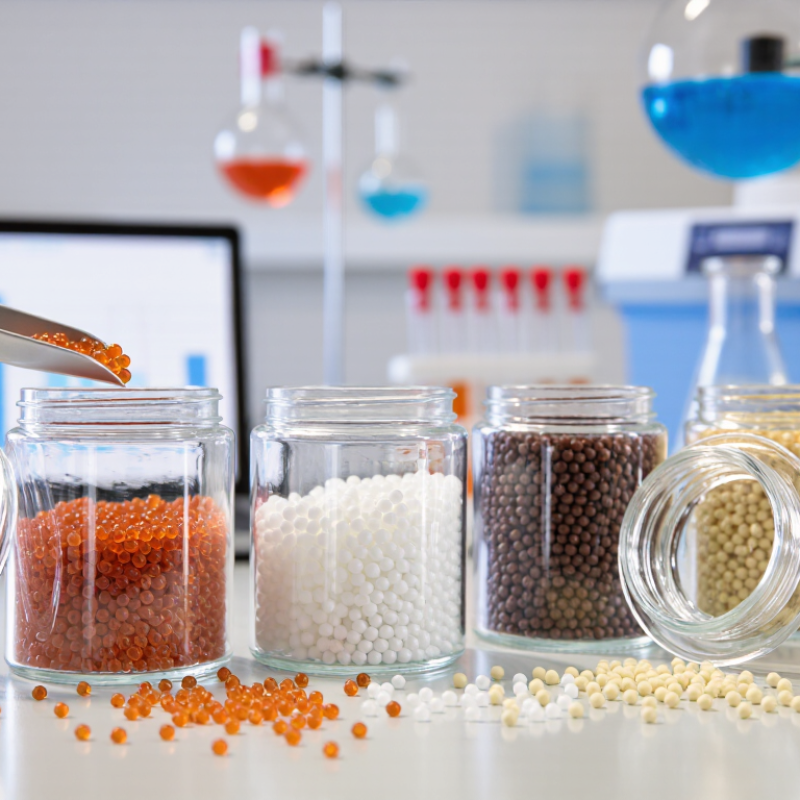
Ion exchange resins differ by the ions they attract, not just by their bead size. Strong-acid cation resins replace calcium and magnesium with sodium, making them common in water softening. Weak-acid cation resins are useful when water contains alkalinity and hardness together. Strong-base anion resins can remove nitrate and other negatively charged contaminants. Weak-base anion resins mainly target mineral acids. Chelating resins bind selected metal ions, while mixed beds combine cation and anion resins for high-purity water.
Match the resin to the water analysis. The U.S. EPA’s Drinking Water Treatability Database identifies ion exchange as a treatment option for nitrate. EPA’s drinking-water standard sets nitrate at 10 mg/L measured as nitrogen. That figure is a compliance limit, not a promise of resin performance. Sulfate and other competing ions can shorten a resin bed’s service run. Test the actual feed water.
Check regeneration needs, waste handling, and the expected flow rate before sizing a system. A small resin column may perform well in a pilot test, then behave differently at full scale. It happens. Resin choice is rarely perfect on paper; operating data may expose assumptions that need revisiting.
Defining the Treatment Goal and Feedwater Conditions
Before choosing an ion exchange resin, define what the treated water must achieve. Is the goal to reduce hardness, remove nitrate, lower conductivity, or protect a downstream process? These targets call for different resin functions. A boiler operator may need low hardness to limit scale, while a laboratory may require very low conductivity. That distinction matters. Set a measurable outlet limit and estimate the required flow and daily water volume. Include peak demand, not just the average. A system that meets a target for one sample may struggle during a busy shift.
Next, examine the feedwater as it actually arrives. Test hardness, alkalinity, pH, conductivity, and relevant ions; check iron, suspended solids, and organic matter where they may affect performance. Measure seasonal or source-water changes if possible. A sample taken after heavy rain may not represent a dry month. Numbers can mislead. Confirm unusual results with repeat testing, and note where each sample was collected. Feedwater temperature and pressure also matter when checking equipment limits. Keep recent lab reports and operating logs together. I have seen selection discussions move too quickly toward resin type before the water data were reliable; that step can lead to short run times, unexpected regeneration, or disappointing product-water quality.
How to Choose the Right Ion Exchange Resin? - Defining the Treatment Goal and Feedwater Conditions
| Treatment goal | Feedwater conditions to check | Typical resin type | Selection notes |
|---|---|---|---|
| Soften water by removing calcium and magnesium | Total hardness (commonly reported as mg/L as CaCO₃), sodium, iron, manganese, suspended solids, and flow rate. | Strong-acid cation (SAC), sodium-cycle | SAC resin exchanges hardness ions for sodium. Elevated iron or manganese and suspended solids can foul or block the bed; pretreatment may be needed. |
| Reduce alkalinity or remove carbonate hardness | Alkalinity, hardness, pH, dissolved carbon dioxide, and the desired effluent alkalinity. | Weak-acid cation (WAC), hydrogen-cycle | WAC is most effective for alkalinity associated with hardness. It does not remove all dissolved salts; performance depends on feed composition and operating conditions. |
| Demineralize water or reduce total dissolved ions | Cations, anions, alkalinity, silica, conductivity, total dissolved solids, and dissolved organic matter. | SAC followed by strong-base anion (SBA), often with a polishing stage | The cation and anion stages remove different groups of ions. Resin configuration and regeneration requirements should be based on a complete water analysis and the required product-water quality. |
| Polish already demineralized water to very low conductivity | Inlet conductivity, residual cations and anions, silica, organic contamination, and required outlet quality. | Mixed-bed cation and anion resins | Mixed beds are commonly used for final polishing rather than as the sole treatment for high-salt feedwater. Upstream treatment helps extend run length. |
| Remove nitrate from drinking-water feed | Nitrate, sulfate, chloride, bicarbonate, total dissolved solids, and applicable drinking-water limits. | Nitrate-selective strong-base anion resin | Competing anions affect capacity and breakthrough. Confirm selectivity, regeneration or disposal requirements, and finished-water compliance using site-specific testing. |
| Remove dissolved metals such as lead or copper | Metal species and concentration, pH, competing ions, suspended solids, and whether metals are dissolved or particulate. | Chelating resin or a suitably selected cation resin | Resin performance depends on metal speciation, pH, and competing ions. Particulate metals generally require filtration; confirm capacity and regeneration strategy with representative water. |
| Remove dissolved organic acids or color | Dissolved organic carbon, color, pH, alkalinity, iron, and suspended solids. | Anion resin selected for organic removal; sometimes a dedicated adsorptive resin | Organic matter can foul conventional demineralization resins and reduce capacity. Resin choice should match the organic compounds present, with pretreatment considered where needed. |
Resin selection is site-specific. Confirm feedwater chemistry, target effluent quality, flow and loading conditions, regeneration method, and applicable regulations before final design.
Matching Resin Chemistry to Target Ions and Operating Needs
Resin chemistry should match the target ion, not a generic “water treatment” label. Strong-acid cation resins remove positively charged ions across a broad pH range. Weak-acid cation resins can suit hardness linked to alkalinity. Strong-base anion resins target a broad range of negatively charged contaminants, while weak-base types are often used for mineral acids. Chelating resins can help capture selected metals. Check pH, competing salts, and feed variability; a bench test can reveal selectivity that a datasheet misses.
The U.S. EPA’s 2024 National Primary Drinking Water Regulation for PFAS sets limits of 4 ng/L for PFOA and PFOS, and 10 ng/L for several other PFAS. Those trace-level targets make resin affinity and leakage control important, not just nominal capacity.
Operating conditions matter too. High salinity can crowd target ions, while suspended solids and organics may foul a bed. Match the resin’s ionic form and regeneration method to the process, then track pressure drop and breakthrough in real feed water. I would not treat catalog capacity as a promise; actual water is rarely so tidy. A short pilot run can expose that gap.
Comparing Capacity, Selectivity, Durability, and Cost
How to Choose the Right Ion Exchange Resin?
Comparing Capacity, Selectivity, Durability, and Cost
Capacity is useful only when it reflects real operating conditions. Many strong-acid cation resins have total capacities around 1.8–2.0 equivalents per liter, as reported in engineering references such as Crittenden et al.’s Water Treatment: Principles and Design. Working capacity is lower when competing ions, leakage limits, and regeneration settings are considered. Ask for performance data using feed water similar to yours, not just a maximum laboratory value. Small details matter.
Selectivity determines which ions the resin captures when the water contains a mix. The U.S. EPA’s 2000 Ion Exchange fact sheet explains that competing ions and pretreatment affect treatment performance. For example, iron or suspended solids can foul a bed and shorten service runs. Durability also depends on cleaning and regeneration practices. Track pressure drop, resin loss, and breakthrough over time; a resin that lasts longer may reduce replacement and downtime costs.
Compare total operating cost, not purchase price alone. Include regenerant, rinse water, wastewater handling, labor, and the cost of resin replacement. A simple spreadsheet helps, but its assumptions can be misleading: actual feed water changes, and regeneration efficiency may drift. Pilot testing can reveal those gaps before full-scale installation. The best choice is the resin that meets the outlet target reliably at a manageable cost under your site’s conditions.
Checking Compatibility, Regeneration, and Maintenance Requirements
Choose a resin for the actual water matrix, not just the target ion. Test hardness, alkalinity, dissolved organic matter, temperature, and competing ions; these can reduce working capacity or cause early breakthrough. For drinking-water projects, set the performance target before sizing the bed. The U.S. EPA’s 2024 PFAS rule sets limits of 4 ng/L for PFOA and PFOS, illustrating how demanding outlet targets can shape resin selection and monitoring. (U.S. EPA, 2024, PFAS National Primary Drinking Water Regulation fact sheet.) Ask suppliers for capacity data under comparable water chemistry, then confirm it with a pilot test. Lab numbers alone can mislead.
Check the full regeneration cycle: chemical type, dose, contact time, rinse volume, and spent-brine handling. Confirm that the resin tolerates the planned regenerant and repeated cycles; a mismatch can cause capacity loss, swelling, or bead damage. Keep a simple log of treated volume, pressure drop, regenerant use, and outlet concentration. Shorter service runs may signal fouling or poor regeneration, not necessarily exhausted resin. EPA’s Drinking Water Treatability Database provides contaminant-specific treatment information, but site testing remains essential. (U.S. EPA, Drinking Water Treatability Database.) Maintenance plans should include sampling ports, safe access for resin inspection, and a schedule for backwashing where the system requires it. Easy to overlook. Even experienced operators can mistake a changing feedwater profile for resin failure. That deserves a second look.
How to Choose the Right Ion Exchange Resin
Common regenerant compatibility by resin class
How to read: A value of 1 indicates a commonly used regenerant for the stated resin and service; 0 means it is not typically the primary regenerant. Acid is commonly used to regenerate cation resins in hydrogen form, while sodium hydroxide is used for anion resins. Sodium chloride brine is commonly used for strong-acid cation resins in sodium-cycle softening. Confirm chemical dose, concentration, and procedure against the resin supplier’s specifications and your water chemistry. Track pressure drop, leakage, and capacity to plan cleaning and replacement.


