


10 Smart Circuit Breaker Buying Tips for Global Buyers

Buying a Smart Circuit Breaker is not simply a matter of choosing the newest app or lowest quotation. Global buyers must match electrical performance, local requirements, and long-term operating conditions. A breaker installed in a humid factory faces different risks from one used in a dry office. Voltage, current rating, poles, frequency, and short-circuit capacity require careful verification.

Practical purchasing experience shows that small details often create expensive problems. Check whether the device supports the target network, such as Wi-Fi, Bluetooth, Modbus, or another approved protocol. Confirm its communication range and data security features. Ask for test reports, technical drawings, installation instructions, and traceable production information. Certification should fit the destination market, not merely the supplier’s export history. Independent testing and review by a qualified electrician add valuable protection.

No checklist is perfect. A low price can look attractive, yet weak terminals or unclear software support may increase maintenance costs. Buyers should examine heat resistance, enclosure quality, manual override functions, and replacement availability. They should also test how quickly alerts appear during overload or abnormal current conditions. That test matters. Supplier responsiveness matters too. Request clear warranty terms and a realistic service plan before placing a large order. The following ten tips help global buyers compare products with greater confidence, reduce avoidable installation risks, and select a Smart Circuit Breaker that performs reliably in its actual environment. JSImport
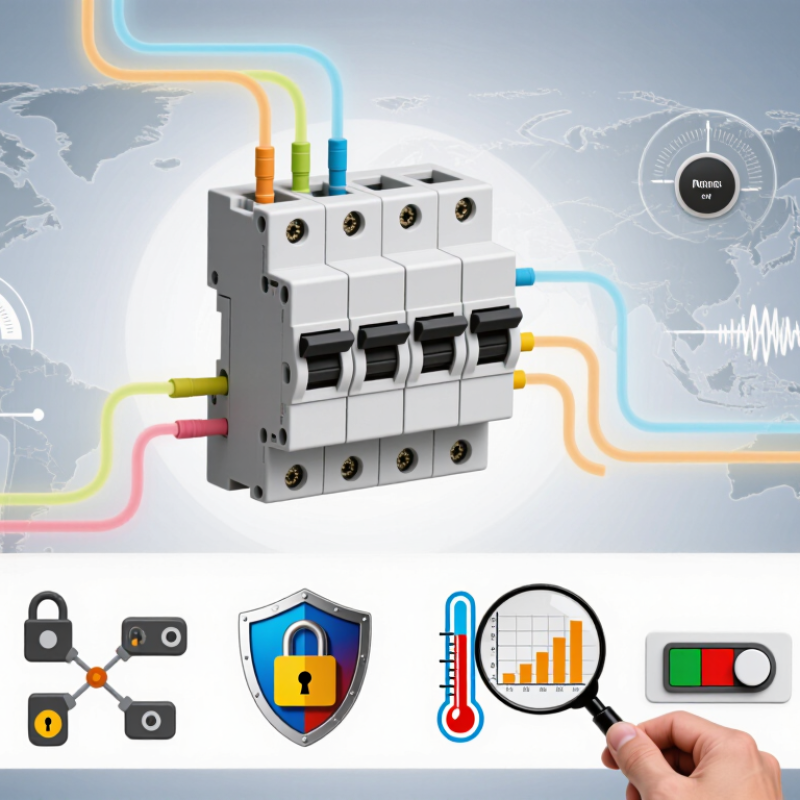
10 Smart Circuit Breaker Buying Tips for Global Buyers

Define Smart Circuit Breaker Features and Core Functions

A smart circuit breaker is more than a remotely controlled switch. It combines protection, measurement, communication, and control in one device. The core function remains essential: interrupting current during overloads or short circuits. Digital features should support this protection, not distract from it.

Look for real-time readings of voltage, current, power, and energy use. These measurements help technicians identify an overloaded circuit before nuisance trips become frequent. Remote switching can simplify maintenance, especially when panels are installed in restricted or distant areas.

However, local manual operation remains important. Networks fail sometimes.

Useful devices record trip events, temperature changes, and abnormal current patterns. Clear logs can reveal loose connections, aging loads, or repeated startup surges. Adjustable protection settings may improve coordination between upstream and downstream breakers, but incorrect settings can create serious risks. Configuration should require controlled access and preserve an audit trail.

Check communication options carefully. Wi-Fi may suit small installations, while wired protocols often provide steadier performance in industrial environments. Secure authentication, encrypted communication, and firmware update controls are practical requirements, not decorative extras. I have seen buyers focus on mobile apps while overlooking response time, data accuracy, and manual recovery. That is an expensive mistake. Review operating temperature, enclosure compatibility, rated current, interruption capacity, and installation space before comparing advanced functions.

Match Voltage, Current Rating, and Electrical System Requirements

A circuit breaker is not a universal safety switch. It must match the system’s voltage, current, frequency, and grounding arrangement. A 230 V single-phase circuit differs greatly from a 400 V three-phase installation or a 120/208 V commercial network. Check the nameplate, wiring diagram, and local code before comparing prices. A breaker rated for 50 Hz may not suit every 60 Hz application, especially in mixed-frequency projects.

Current rating needs careful calculation. Do not simply choose the largest available number. Confirm the continuous load, conductor capacity, starting current, and expected temperature. The IEA’s Electricity 2024 report forecasts average global electricity-demand growth of about 3.2% annually from 2024 to 2026. That growth may increase loading in factories, buildings, and charging systems. Derating matters. Heat inside a crowded enclosure can reduce practical capacity.

Breaking capacity is equally important. IEC 60898-1 covers many household and similar applications, while IEC 60947-2 addresses broader industrial circuit-breaker requirements. Compare the prospective short-circuit current with the breaker’s interrupting rating. Also verify pole configuration, neutral switching, trip curve, and AC or DC compatibility. I have seen installations where the voltage looked correct, but the neutral arrangement was wrong. That mistake is easy to miss. Ask for test certificates, technical drawings, and temperature data. Recheck everything.

Evaluate Safety Standards, Certifications, and Protection Capabilities

10 Smart Circuit Breaker Buying Tips for Global Buyers

Safety should guide every smart circuit breaker purchase. NFPA research on 2015–2019 home fires linked electrical distribution and lighting equipment to about 35,150 fires annually. These incidents caused roughly 470 deaths and 1,100 injuries each year. Check whether the breaker follows the correct standard, such as IEC 60898-1 for household protection or IEC 60947-2 for industrial applications. Do not accept a generic “international certified” claim.

Ask for the full test report, certificate number, and Declaration of Conformity. For European markets, CE marking shows regulatory compliance, not superior product quality. Confirm the local rules yourself. A certificate may cover one model, voltage range, or accessory only. That detail is easy to miss. Verify short-circuit breaking capacity, rated current, pole configuration, temperature limits, and trip curves. The device should also state whether it protects against overload, short circuit, earth leakage, or arc faults.

Smart features need equal scrutiny. Test remote tripping, manual reset, event records, and loss-of-network behavior. A breaker should still protect the circuit when the application or Wi-Fi fails. Check encryption practices and firmware update procedures. The International Energy Agency’s Electricity 2024 report projects continued global electricity-demand growth, increasing pressure on reliable distribution systems. Yet a polished dashboard cannot replace verified protection performance. I would also question unclear test dates, missing calibration records, and sellers who avoid sample testing.

Compare the maximum AC voltage covered by widely used circuit-breaker standards before purchasing. IEC 60898-1 is intended for household and similar installations, IEC 60947-2 covers industrial low-voltage switchgear, and UL 489 applies to molded-case circuit breakers rated up to 600 V. These scope limits do not replace verification of the product’s actual voltage, current, breaking-capacity, temperature, IP rating, and required local certification.

Compare Connectivity, Monitoring Options, and Control Platforms

A smart circuit breaker is useful only when its connectivity fits the installation. Compare Wi-Fi, Ethernet, cellular, and wired communication before choosing a model. Wi-Fi suits small buildings, but thick concrete walls can weaken signals. Ethernet offers steadier communication near control panels. Cellular access helps remote sites, although subscription costs require careful planning.

Test it on site. Place the breaker inside its intended cabinet and measure signal strength with doors closed. Monitoring should show current, voltage, power, energy use, temperature, and trip events. Clear timestamps matter when technicians investigate a night-time shutdown. Check whether data exports through common formats or secure interfaces. Closed systems can become expensive during future upgrades.

Control platforms deserve equal attention. Look for mobile, web, and local access, with separate permissions for operators and administrators. A good platform records commands, alarm responses, and configuration changes. It should also continue basic protection when the network fails. Offline control matters. During field inspections, I have found that complicated dashboards slow emergency decisions. Simple screens often work better. However, simplicity can hide missing details, so review sample reports before purchase. Ask about firmware updates, data storage locations, encryption, and support response times. Requirements differ by country, voltage system, and building type, so local technical review remains essential.

Assess Suppliers, Total Cost, Installation, and After-Sales Support

When buying smart circuit breakers internationally, assess the supplier beyond a polished website. Request factory details, product test reports, wiring diagrams, and traceable quality records. Ask for evidence. Check whether the supplier understands your voltage, frequency, enclosure, and communication requirements. A technically strong supplier should explain limits clearly, not promise universal compatibility.

Compare total cost, not only the quoted unit price. Include shipping, import charges, gateway devices, software access, spare breakers, commissioning, and technician training. A low-cost breaker can become expensive when terminals need replacement or installation instructions are unclear. Request a sample before placing a large order. Test remote switching, overload protection, power readings, and reconnection behavior under controlled conditions. Do not guess. Record each result.

Installation quality affects safety and data reliability. Confirm that a qualified local electrician can install the device inside your distribution board. Leave space for heat dissipation and label every circuit. Ask whether the supplier provides live support during commissioning. After-sales terms should state response times, replacement procedures, firmware support, and warranty exclusions. Keep these details in writing. No checklist is perfect. I would still allow budget for unexpected adapters, delayed parts, or an electrician’s extra visit. That small reserve may prevent a rushed and unsafe installation.

10 Smart Circuit Breaker Buying Tips for Global Buyers - Assess Suppliers, Total Cost, Installation, and After-Sales Support

No. Buying Dimension What to Check Typical Technical Benchmark Recommended Buyer Action Common Risk if Ignored
1 Match the Applicable Standard Confirm the product standard, test edition, declaration of conformity, and destination-market requirements. IEC 60898-1 is commonly used for household and similar miniature circuit breakers; IEC 60947-2 is commonly used for industrial circuit breakers. Request the complete test report, certificate scope, product marking, and traceable model number before approval. Non-recognition by inspectors, customs delays, unsafe installation, or rejection by the end customer.
2 Verify Electrical Ratings Check rated current, poles, rated voltage, frequency, tripping curve, and breaking capacity. Common low-voltage ranges include 1–63 A for many miniature breakers, 230/400 V AC systems, and 4.5–10 kA breaking capacity depending on the application. Select ratings from the project load calculation and prospective short-circuit current, not only from price or availability. Nuisance tripping, cable overheating, insufficient fault interruption, or equipment damage.
3 Assess Smart Functions Review remote switching, energy measurement, overload alerts, fault notifications, scheduling, and local manual operation. Energy-measurement accuracy is often specified as a percentage of reading; communication may use Wi-Fi, Bluetooth, Zigbee, Modbus, or another documented protocol. Require a feature matrix, communication protocol details, app permissions, API availability, and offline operating behavior. Limited interoperability, inaccurate data, loss of control during internet outages, or unexpected subscription costs.
4 Compare Total Cost of Ownership Include product price, freight, duties, installation labor, gateway costs, software fees, testing, spare parts, and replacement costs. A lower purchase price can be offset by communication hubs, paid cloud services, special tools, or higher installation labor. Build a 3–5 year landed-cost comparison using the same quantity, delivery term, currency, and service assumptions. Budget overruns and a lower return on investment despite an attractive initial quotation.
5 Evaluate Supplier Capability Review quality-management processes, production capacity, inspection records, traceability, export experience, and technical documentation. A credible supplier should provide consistent model identification, batch records, incoming and outgoing inspection procedures, and documented corrective actions. Use a supplier questionnaire, request recent sample documents, and conduct a sample or pre-shipment inspection for larger orders. Inconsistent batches, counterfeit documentation, shipment defects, or inability to scale production.
6 Check Installation Compatibility Confirm enclosure dimensions, DIN-rail compatibility, terminal size, wiring direction, neutral requirements, and available panel space. Many modular devices use DIN-rail mounting, but width, terminal capacity, heat dissipation, and wiring arrangements vary by model. Obtain dimensional drawings, wiring diagrams, torque values, and a complete installation manual before site work. Rework, panel modifications, loose terminals, overheating, or failure to fit the existing distribution board.
7 Confirm Environmental Suitability Assess operating temperature, humidity, altitude, dust, moisture, vibration, and indoor or outdoor installation conditions. Indoor modular equipment commonly has a basic enclosure protection level; outdoor or damp locations may require a separately rated enclosure. Compare the product environmental specification with the enclosure rating and actual site conditions. Condensation, corrosion, communication failures, shortened service life, or unsafe exposure to moisture and dust.
8 Review Lead Time and Supply Continuity Check minimum order quantity, sample availability, production lead time, capacity during peak demand, and spare-part availability. Standard products may be available from stock, while customized firmware, labels, packaging, or accessories can extend delivery by several weeks. Obtain a written production schedule and define delivery milestones, safety stock, and an approved substitute policy. Project delays, line stoppages, emergency freight, or incompatibility caused by last-minute substitutions.
9 Measure Warranty and After-Sales Support Verify warranty duration, response time, return procedure, remote troubleshooting, firmware policy, and replacement-part coverage. A clearly written 12–24 month warranty is common in many commercial quotations, but coverage exclusions and shipping responsibility must be defined. Add service-level targets, technical escalation contacts, failure-analysis requirements, and replacement timelines to the purchase agreement. Long downtime, disputed warranty claims, repeated failures, and high field-service expenses.
10 Run a Pilot and Acceptance Test Test protection behavior, communication stability, energy readings, installation workflow, cybersecurity controls, and user permissions. Pilot testing should cover normal operation, overload or fault simulation where safe, power loss, network loss, firmware updates, and recovery behavior. Approve a small trial batch first and document pass/fail criteria before releasing the full purchase order. Unexpected field failures, inaccurate monitoring, cybersecurity weaknesses, and expensive mass replacement.
Buyer’s rule of thumb: Approve a smart circuit breaker only when its electrical ratings, applicable standards, installation requirements, total landed cost, supply continuity, and after-sales obligations are documented and verified.
Packaging machine ROI calculator

Need help figuring out if packaging automation is right for your business?


First, start with the numbers. Download our free packing machine ROI calculator to learn how long it will take for an investment in automation to pay for itself (and much more).


Free packaging automation ROI calculator