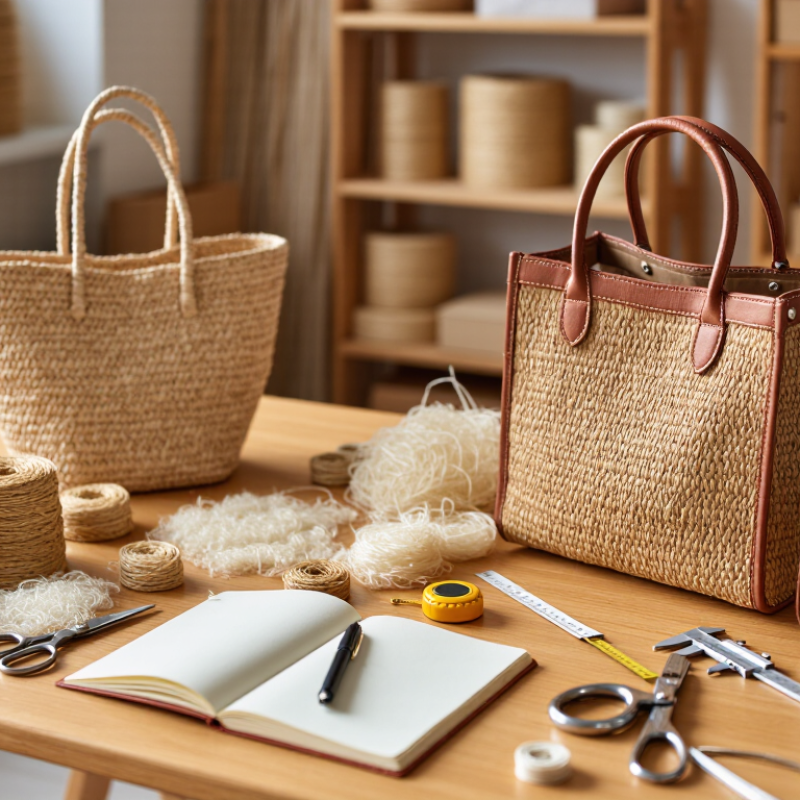
How to Source Natural Raffia Bags in 2026?
In 2026, sourcing Natural Raffia Bags takes more than comparing prices. Buyers need to understand the material, inspect workmanship, and confirm that a supplier can meet their order requirements. Start by defining the intended use: a lightweight beach tote, a structured market bag, or a small accessory may need different weaving, lining, and handle construction. Details matter. Ask suppliers to identify the raffia they use and explain how it is harvested, processed, dyed, and stored. Clear answers are more useful than broad sustainability claims.
Request samples before approving production. Check for loose fibers, uneven stitching, sharp edges, and handles that pull under light pressure. Compare measurements, weight, color consistency, and packaging with your product specifications. A photo cannot show everything. Ask how the workshop manages quality checks, production capacity, lead times, and replacements for defective goods. Verify these points through written records and, where practical, an independent inspection. Supplier credentials can support your assessment, but they do not replace direct checks.
Costs may include sampling, custom labels, packaging, transport, and duties, so request an itemized quotation. Clarify minimum order quantities and payment milestones before committing. Ethical and environmental claims deserve careful review; ask for evidence that matches the specific product and supply chain. The first sample may disappoint. That is useful information, not a reason to rush approval. This guide explains how to compare suppliers, assess quality, and build a sourcing process grounded in practical evidence and realistic expectations.
Map 2026 Raffia-Bag Trade with UN Comtrade HS 4602.19 Data
To map 2026 trade in natural raffia bags, begin with UN Comtrade records under HS 4602.19. This six-digit code covers other articles made from plaiting materials. It does not isolate raffia bags. That distinction matters. Shipments may include baskets, mats, and other woven goods, so trade totals are useful signals, not bag-specific measurements.
Compare exporting and importing reporters, partner countries, trade value, and reported quantity. Look for recurring supplier markets rather than relying on one unusually large shipment. Check whether values are reported in US dollars and note the quantity unit; kilograms and item counts tell different stories. UN Comtrade data can arrive late or be revised. For 2026, compare the latest available months with complete prior-year data, and avoid treating partial-year figures as a full-year forecast.
Use the numbers to guide sourcing questions. A rising import value may reflect higher prices, more volume, or a changing product mix. It does not prove that demand for raffia bags has grown. Ask suppliers for material composition, construction details, packing quantities, and shipment dates, then compare those details with the trade pattern. Classification can depend on the article’s materials and design, so verify the applicable customs code with a qualified trade professional before making decisions. The data is helpful, but imperfect.
Verify Raffia Fiber Composition, Species, and Country of Origin
When a supplier calls a bag “natural raffia,” ask what the fiber actually is. Commercial names can cover different materials, including raffia palm fiber, paper, or synthetic blends. Request a written composition statement for the bag body, handles, lining, and trim. Ask for the botanical name where available; Raphia is a useful starting point, not proof by itself. Names can mislead.
Compare the statement with a physical sample. Raffia often shows irregular strands, subtle color variation, and a dry, papery feel, but appearance alone cannot authenticate it. Keep the sample. Request close-up photos of raw fiber and finished seams, plus batch records linking the sample to production. If a lab test is warranted, agree on its method and scope before ordering; not every test reliably identifies plant species.
Treat country of origin as a traceability question, not a label detail. Ask where the palm was harvested, where the fiber was processed, and where the bag was woven and assembled. These may be different places. Check invoices, supplier declarations, and available harvest or mill records against one another; a dispatch address only shows shipment, not origin. Records can be incomplete, especially across small workshops, so note gaps and avoid presenting estimates as verified facts. A tidy document is not certainty.
Compare Supplier MOQ, Monthly Capacity, and Production Lead-Time Records
When sourcing natural raffia bags, compare supplier records, not just quoted prices. Ask for the minimum order quantity by style, color, and size; a single MOQ may hide setup costs or material limits. Request monthly capacity for the exact handwoven construction, and separate total capacity from slots already committed. Check production records from the past six to twelve months, including promised and actual ex-factory dates. A spreadsheet can look reassuring. It can also be incomplete.
The World Bank’s 2023 Logistics Performance Index covered 139 economies and assessed six areas, including timeliness and logistics competence. It does not measure factory lead times, but it reinforces why shipping estimates and production schedules should be checked separately. Ask suppliers to show dated purchase orders, sample approvals, production start dates, and shipment-ready dates. Calculate the share of orders completed on time, and ask what caused delays. Rain, raffia availability, and hand-weaving complexity can affect schedules.
Compare like with like. Use the same bag dimensions, weave density, finishing, and order quantity when reviewing quotes. Request a capacity plan for peak months, not only an annual maximum. Then verify a recent order against its paperwork. One awkward discrepancy matters. A supplier’s best month may not represent a normal month.
How to Source Natural Raffia Bags in 2026? — Compare Supplier MOQ, Monthly Capacity, and Production Lead-Time Records
Planning benchmarks, not audited supplier records. The ranges below are indicative estimates for custom natural raffia bag orders. Actual terms depend on bag design, material availability, finishing, quality requirements, and the supplier’s current workload. Confirm all figures directly with shortlisted suppliers.
| Production Setup | Typical Custom-Order MOQ | Indicative Monthly Capacity | Typical Production Lead Time | Best Fit | What to Verify Before Ordering |
| Small artisan workshop | 50–150 bags per style | Approximately 200–800 bags | 30–60 days after sample approval | Small launches, limited editions, and designs with substantial hand-finishing | Worker availability, consistent dimensions, material sourcing, and capacity reserved for the order |
| Established workshop with several production teams | 100–300 bags per style | Approximately 800–2,500 bags | 25–50 days after sample approval | Repeat orders and medium-sized seasonal collections | Recent production schedule, daily output by bag type, inspection process, and repeat-order consistency |
| Organized producer with dedicated finishing and quality-control stages | 200–500 bags per style | Approximately 2,000–6,000 bags | 20–45 days after sample approval | Larger orders requiring coordinated finishing, labeling, and packing | Capacity evidence for the requested construction, material traceability, defect handling, and packing specifications |
| Multi-site or production-network setup | 300–1,000 bags per style | Approximately 5,000–15,000 bags across the network | 30–60 days after sample approval | High-volume programs where production can be distributed across teams or sites | Whether capacity is confirmed or theoretical, how work is allocated, and how quality standards are kept consistent across sites |
| Stock or semi-custom program | 50–200 bags, depending on available stock | Variable; dependent on finished-goods inventory | 7–21 days for available stock; longer for replenishment or customization | Quick tests, simpler customization, and urgent replenishment | Current stock count, material and color availability, customization limits, and dispatch-ready date |
Set AQL 2.5/4.0 Defect Limits Using ISO 2859-1 Sampling Plans
For natural raffia bags, define defects before inspection: a split handle seam may be major, while a loose thread may be minor. Acceptable color and weave variation should be documented using approved samples. Otherwise, inspectors may reject natural material inconsistently. Keep it practical.
Use AQL 2.5 for major defects and 4.0 for minor defects as agreed contract limits, not promises that every shipment contains those exact percentages. ISO 2859-1:1999, Table II-A, gives a concrete reference: for normal single sampling at General Inspection Level II, a lot of 3,201–10,000 units uses a 200-piece sample. At AQL 2.5, acceptance is 10 defects and rejection is 11; at AQL 4.0, acceptance is 14 and rejection is 15. Confirm the applicable edition and plan with your inspector. Critical safety or functional failures can require zero acceptance.
Record lot size, sample code, defect category, and inspection result on the report. Photograph defects beside a ruler, especially uneven handles and gaps in stitching. Raffia varies. That can complicate judgment. I have seen teams spend more time debating “natural texture” than checking weak seams. Set visual limits with suppliers before production, and review borderline findings together.
Check EU GPSR Traceability Rules, Applicable Since 13 December 2024
How to Source Natural Raffia Bags in 2026?
Check EU GPSR Traceability Rules, Applicable Since 13 December 2024
When sourcing natural raffia bags for EU consumers, ask suppliers how each bag can be traced. The General Product Safety Regulation (GPSR) has applied since 13 December 2024. It covers consumer products, including bags, and requires clear identification and responsible economic operators. Request the manufacturer’s name and postal and electronic contact details, plus a batch, model, or other product identifier. Keep invoices and production records that connect those details to each shipment.
Ask for records showing where the raffia was sourced, where bags were made, and which dyes, linings, or handles were used. Useful records should match the actual goods, not just a generic supplier profile. Check a sample for loose fibers, sharp wire ends, weak handles, and color transfer. Small details matter. If the manufacturer is outside the EU, confirm who is the EU-based responsible person and retain their contact information. Online listings also need specified manufacturer, responsible-person, product-identification, and warning information.
Do not assume a natural material makes a product automatically safe. Nor does an ordinary raffia bag generally need CE marking under the GPSR. Ask suppliers to explain any product-specific risks and how they address them. Paperwork can look complete while batch numbers fail to match carton labels. That is easy to miss, and worth checking before goods leave the factory.