


Top 10 Welding Parts Manufacturers in China for Global Buyers

Choosing a welding supplier is rarely just a price comparison. For global buyers, Welding Parts must meet practical requirements for fit, strength, finish, and repeatability. A bracket that looks acceptable in a sample may still cause problems during assembly if its dimensions vary between production runs. Small details matter.

This guide introduces ten Chinese manufacturers for buyers evaluating potential sourcing partners. The list is a starting point, not a substitute for verification. Supplier capabilities can differ by material, welding process, production volume, and inspection method. Buyers should review drawings, tolerances, sample parts, quality records, and relevant certifications before placing orders. It is also worth asking how a manufacturer handles material traceability, production changes, packaging, and shipping schedules. Clear answers often reveal more than a polished catalog.

No shortlist fits every project. A factory suited to custom, low-volume parts may not be the best choice for large, repeat orders. Likewise, a strong technical team does not automatically guarantee smooth communication or reliable delivery. Requesting a sample run and agreeing on acceptance criteria can reduce uncertainty, though it takes time and effort. That is an imperfect step, but a useful one. The profiles ahead can help buyers compare manufacturers more carefully and prepare focused questions before requesting quotations.
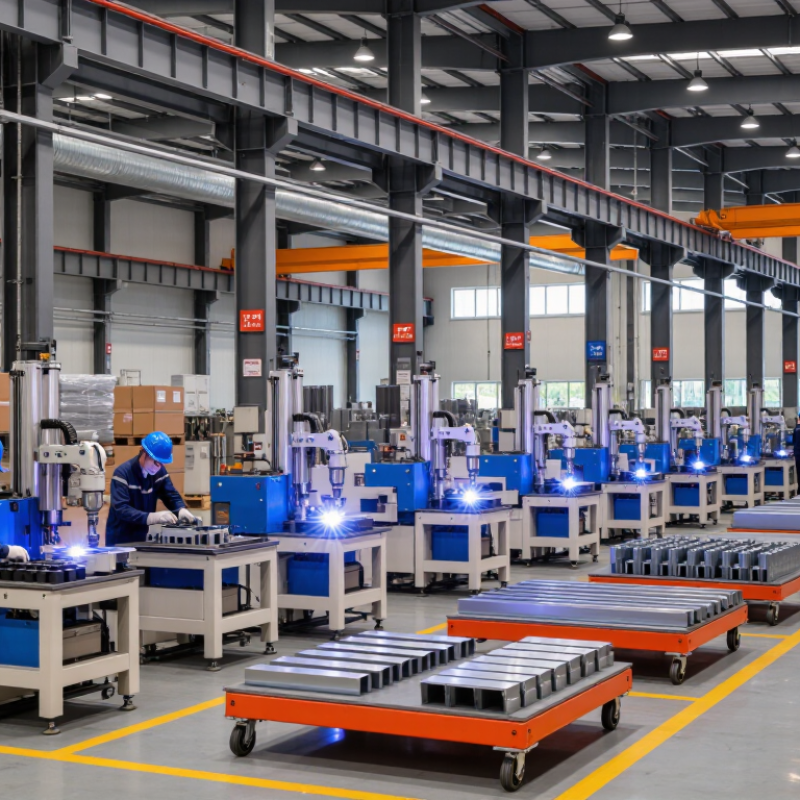
Top 10 Welding Parts Manufacturers in China for Global Buyers

Welding Parts in China: Core Products, Materials, and Manufacturing Processes

Welding parts made in China cover brackets, frames, flanges, pipe supports, and machine housings. Material choice shapes strength, weight, corrosion resistance, and cost. Carbon steel suits many structural parts; stainless steel is common where moisture or cleaning chemicals are concerns. Aluminum can reduce weight, but it needs careful heat control. Small details matter. A 2 mm bracket and a thick equipment frame should not share a welding plan.

The World Steel Association’s World Steel in Figures 2025 reports that China produced about 1,005 million tonnes of crude steel in 2024, out of roughly 1,883 million tonnes worldwide. This scale supports a broad steel supply base, but it is only a proxy for welding-part capacity, not a count of finished components. Buyers should check actual material certificates and traceability. Paperwork can look tidy; the part still needs inspection.

Common production steps include laser or plasma cutting, bending, machining, and fixture-based welding. MIG/MAG is widely used for carbon-steel assemblies, while TIG is often chosen for thinner sections or cleaner visible seams. Resistance welding can suit repeated sheet-metal joints. After welding, parts may need grinding, dimensional checks, and protective coating. ISO 3834 describes quality requirements for fusion welding of metallic materials. Ask suppliers how they control distortion, weld penetration, and batch variation. Those details are easy to overlook.
How to Compare the Top 10 Manufacturers by Capacity, Lead Time, and MOQ

When comparing ten welding parts manufacturers in China, look beyond stated annual capacity. Ask how many production hours are available for your order, and whether welding fixtures, operators, and inspection staff are assigned. A factory may list high output but have limited open slots. Request recent production figures for parts with similar material thickness, joint design, and tolerance requirements. A sample schedule or anonymized order record can help verify the answer. Numbers need context.

Lead time should cover more than welding. Clarify the separate durations for material sourcing, drawing approval, sample production, batch manufacturing, inspection, and packing. Ask what happens if a sample needs adjustment; even a small fixture change can shift the shipment date. Compare the quoted timeline against your required delivery window, not just the shortest offer. Be precise.

MOQ also deserves a practical check. It may reflect setup time, material purchasing, or the cost of dedicated fixtures. Ask whether a pilot batch is possible and whether the unit price changes at higher quantities. For a fair comparison, send every manufacturer the same drawings, material specifications, tolerances, forecast, and packaging requirements. Then compare written quotations and production assumptions side by side. I would not treat a low MOQ as an automatic advantage; it can come with longer lead times or higher setup costs. A short factory call can reveal gaps that a polished quotation misses.

Top 10 Welding Parts Manufacturers in China for Global Buyers — How to Compare the Top 10 Manufacturers by Capacity, Lead Time, and MOQ

How to read this comparison: The entries below are anonymous supplier profiles, not named or ranked companies. Capacity, lead time, and MOQ figures are indicative planning benchmarks for Chinese welding-parts sourcing, not verified disclosures from specific manufacturers. Actual figures depend on material, dimensions, welding process, inspection requirements, and order mix; confirm them with a written quotation.

Anonymous Supplier Profile Typical Product Focus Indicative Monthly Capacity Typical Production Lead Time Indicative MOQ Common Processes & Equipment Best Fit for Global Buyers
Profile 1 — Large structural fabricator Heavy frames, bases, supports, and structural assemblies 300–800 tonnes 30–60 days 10–20 pieces, or one project lot MIG/MAG and submerged-arc welding; large-positioner work cells; CNC cutting High-volume or heavy-duty projects with repeatable drawings and planned releases
Profile 2 — Mid-sized custom weldment shop Machine frames, brackets, housings, and equipment weldments 80–250 tonnes 25–45 days 20–50 pieces MIG/MAG and TIG welding; laser or plasma cutting; fixture-based assembly Buyers needing a balance of engineering support, batch flexibility, and production scale
Profile 3 — Precision sheet-metal fabricator Enclosures, panels, cabinets, covers, and light-gauge brackets 40–150 tonnes 20–40 days 50–100 pieces Laser cutting, press brakes, spot welding, MIG/TIG welding, and powder coating coordination Enclosure and panel programs with frequent revisions or multiple sheet-metal parts
Profile 4 — Robotic production specialist Repeat-order brackets, subframes, and standardized welded assemblies 100–350 tonnes 30–50 days, including fixture setup where required 100–300 pieces Robotic MIG/MAG cells, dedicated fixtures, CNC cutting, and batch inspection Stable designs and recurring orders where automation can improve consistency and unit cost
Profile 5 — Low-volume prototype and job shop Prototypes, repair parts, one-off weldments, and pilot batches 10–60 tonnes 10–30 days after drawing and material approval 1–10 pieces Manual MIG/TIG welding, general machining, and flexible cutting services Product development, samples, urgent replacement parts, and low-volume validation runs
Profile 6 — Stainless-steel fabrication specialist Stainless frames, tanks, skids, guards, and hygienic equipment parts 30–120 tonnes 25–50 days 10–30 pieces, depending on finish and material grade TIG and MIG welding; stainless-compatible work areas; passivation or finishing coordination Projects requiring stainless grades, controlled surface finish, or documented material traceability
Profile 7 — Heavy equipment component supplier Loader, agricultural, construction, and mining-equipment weldments 150–500 tonnes 35–65 days 20–100 pieces MIG/MAG and submerged-arc welding; heavy plate cutting; machining and load-bearing inspection Buyers sourcing robust components with defined structural, dimensional, and inspection requirements
Profile 8 — Sheet-metal and enclosure supplier Electrical cabinets, control boxes, frames, and welded sheet assemblies 50–200 tonnes 20–40 days 30–100 pieces Laser cutting, punching, bending, spot welding, and MIG/TIG welding Export programs requiring a mix of fabricated parts, consistent fit, and coordinated finishing
Profile 9 — Machining-and-welding integrator Welded bases, precision frames, and assemblies requiring post-weld machining 40–180 tonnes 30–55 days 10–50 pieces MIG/TIG welding, CNC machining, stress-relief coordination, and dimensional inspection Assemblies with machined datums, tight interface tolerances, or multiple production steps
Profile 10 — Export-oriented mixed-batch fabricator General industrial brackets, supports, frames, and made-to-print components 60–220 tonnes 25–45 days 20–80 pieces MIG/MAG and TIG welding; CNC cutting and bending; packing and export-document coordination Overseas buyers consolidating several custom part numbers into regular shipment batches

Weld Quality Benchmarks: ISO 5817 Acceptance Levels B, C, and D

For global buyers comparing welding-parts manufacturers in China, ISO 5817 provides common acceptance criteria for imperfections in fusion-welded joints. Its quality levels B, C, and D set progressively less stringent requirements: B is the most demanding, C is intermediate, and D is less demanding. They are not overall product grades. A part accepted at level D is not automatically unsuitable; its required level depends on design, service conditions, and the drawing. Put the chosen level on the purchase specification, rather than relying on “high quality” as a vague promise.

Tips: Ask for the applicable standard edition, weld maps, inspection records, and the agreed acceptance level. Confirm whether visual inspection alone is enough, or whether specified non-destructive testing is needed. Check sample parts, too.

A tidy report can still miss a small root mismatch or surface irregularity, so align inspection methods with the joint and its risks. Buyers should review how the supplier records repairs and handles nonconforming welds. Keep the requirements consistent across drawings, purchase orders, and inspection plans. This takes extra discussion. It can prevent a late disagreement over whether a visible imperfection is acceptable, especially when parts are already packed for shipment.

Top 10 Welding Parts Manufacturers in China for Global Buyers — Weld Quality Benchmarks: ISO 5817 Acceptance Levels B, C, and D

How to read this chart: ISO 5817 quality level B is the most stringent, C is intermediate, and D is the least stringent of the three. The 3–1 scale shows ordinal ranking only; it is not a measured acceptance limit. Permitted imperfection dimensions depend on the imperfection type and relevant joint details, so buyers should verify the applicable ISO 5817 requirements for each weld.

Verify Supplier Credentials with ISO 3834 and ISO 9606-1

For global buyers comparing Chinese welding parts manufacturers, a certificate is a starting point, not proof of consistent weld quality.

ISO 3834 sets quality requirements for fusion welding of metallic materials. Check that the certificate covers the actual facility, product scope, and welding processes used for your order. ISO itself does not certify suppliers. Verify the issuing body and certificate validity independently.

ISO 9606-1 addresses welder qualification for fusion welding of steels.

Ask for current records showing the process, material group, thickness range, and welding position relevant to your parts. A qualification is specific, not a universal licence to weld every joint. Details matter. Compare records with the weld maps and production samples; look for matching identification on parts, inspection reports, and consumable logs.

The scale makes careful checks worthwhile: World Steel Association data reports China produced about 1.02 billion tonnes of crude steel in 2023. That figure describes capacity, not workmanship. ISO’s 2023 Survey counted more than 1.2 million ISO 9001 certificates worldwide, yet general quality certification alone does not establish welding competence.

Paper is not proof.

Request a recent audit record and trace one sample part from material receipt through welding and final inspection. Some paperwork can look convincing while missing the shop-floor details that matter.

Assess Export Readiness Through AWS D1.1, NDT, and Traceability

For global buyers comparing welding parts manufacturers in China, export readiness begins with evidence, not a polished quotation. Ask how each supplier applies AWS D1.1 requirements to the specific project, including approved welding procedures and welder qualification records. Check that the code edition matches the contract and that any deviations are documented. A certificate alone is not proof that every production weld followed the required process. That matters.

Non-destructive testing should have a clear scope: method, inspection stage, acceptance criteria, and report linked to the part or weld. Request sample reports and confirm who performed the inspection and reviewed the results. For traceability, follow a part from its material heat number through cutting, welding, inspection, and final packing. Batch labels, weld maps, and dated records make this practical. Small gaps matter. A scanned report can look complete while missing the drawing revision or part identification. Suppliers may not have perfect records on the first review; note the gap, request a correction, and verify the revised evidence before shipment.

Packaging machine ROI calculator

Need help figuring out if packaging automation is right for your business?


First, start with the numbers. Download our free packing machine ROI calculator to learn how long it will take for an investment in automation to pay for itself (and much more).


Free packaging automation ROI calculator