


Top USB Charging Cable Suppliers in China for Global Buyers
Global buyers choosing a Usb Charging Cable supplier in China need more than an attractive catalog. They need clear specifications, consistent production, and evidence that samples match shipped goods. As USB-IF President Jeff Ravencraft’s guidance can be paraphrased: “A USB-C connector alone does not define a cable’s power or data capability.” That distinction matters. A cable may look identical to another, yet differ in supported charging power, data speed, materials, and construction.
This guide examines Chinese suppliers through practical sourcing questions. Can the factory explain its cable structure, connector options, and testing process? Are sample results, production lead times, minimum order quantities, and quality records shared clearly? Buyers should also check how suppliers manage incoming materials, inspection points, and batch traceability. A close look at a connector shell or strain relief can reveal details a product photo misses. Small details count.
Supplier claims deserve verification. Request technical documents, compare samples against the agreed specification, and confirm how defects are handled before placing a large order. Certifications and test reports may help, but their scope and validity still need review. No single checklist removes every risk. Some suppliers communicate well before an order and less clearly afterward; that is worth noticing. The following overview highlights established supplier options, their product strengths, and questions global buyers can use to assess fit. It is a starting point, not a substitute for independent due diligence.
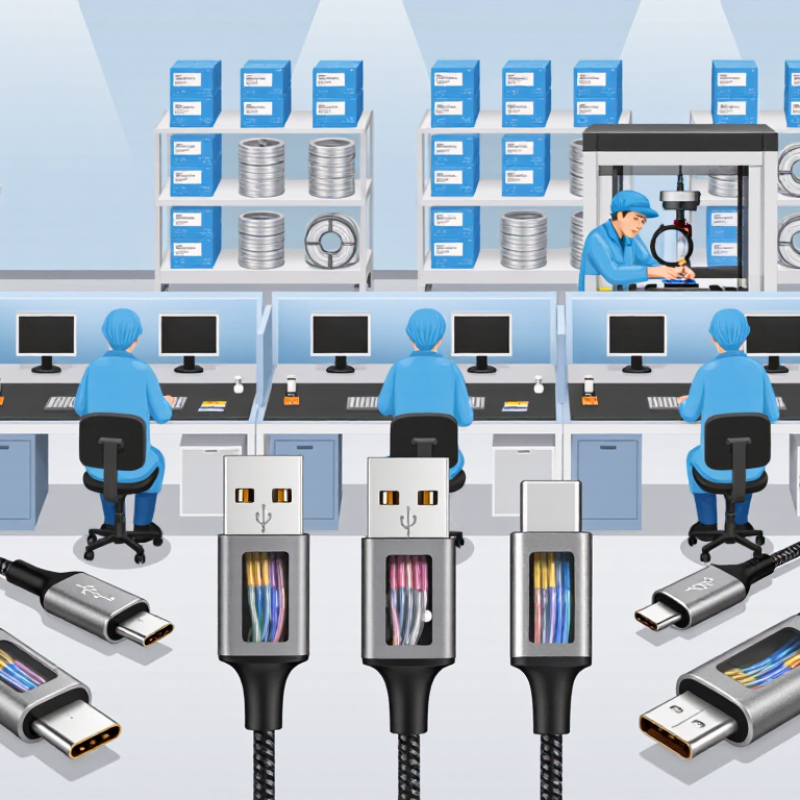
China’s USB Charging Cable Supply Landscape
China’s USB charging cable supply landscape combines component sourcing, assembly, testing, and export services. Many factories operate in electronics manufacturing regions, where connector parts, wire, molding, and packaging can move through short logistics routes. Products range from basic charging leads to cables with varied lengths, outer jackets, connector types, and data functions. Buyers should compare specifications, not just catalog photos or quoted prices. Cables that look alike may differ in conductor size, shielding, strain relief, and batch consistency. Details matter.
Reliable sourcing usually starts with samples and written acceptance criteria. Ask for conductor material, rated current, connector dimensions, jacket material, and relevant test records. Confirm whether data transfer is required, since charging-only and data cables are not interchangeable. During production, inspect a sample from the actual order, not only a pre-production piece. This distinction is easy to miss. For repeat orders, track defects, delivery variation, and packaging accuracy across several batches. A supplier’s capacity may look impressive on paper, yet a rushed material change can affect cable flexibility or plug fit. Request clear notice of changes and keep a reference sample. No supplier is perfect; traceable specifications and candid communication matter more than polished claims.
Top USB Charging Cable Suppliers in China for Global Buyers - China’s USB Charging Cable Supply Landscape
This comparison summarizes common cable configurations, published interface capabilities, and practical sourcing checks. Actual performance depends on the cable, charger, and connected device; confirm specifications for each product and order.
| Product Category | Typical Interface Capability | Key Specification to Confirm | Useful Supplier Evidence | Best-Fit Buying Considerations |
|---|---|---|---|---|
| USB-C to USB-C charging cable | USB Power Delivery cables can support up to 240 W when the cable and connected equipment support USB PD 3.1 Extended Power Range (EPR). | Rated power, supported voltage and current, USB data rate, and whether an electronic marker is present when required by the cable rating. | Product specification sheet, test reports for the stated rating, and a sample that can be checked with the intended charger and device. | Suitable for newer phones, tablets, and laptops. A USB-C connector alone does not guarantee a particular charging power or data rate. |
| USB-A to USB-C charging cable | Supports charging and, where implemented, USB data transfer. Charging performance depends on the USB-A source, cable design, and device. | Supported charging protocols, maximum current, conductor size, cable length, and data-transfer capability. | Clear protocol and current ratings, sample test results with target devices, and confirmation that charging and data functions match the order specification. | Often selected for compatibility with existing USB-A chargers and computers. Do not infer fast charging from connector type alone. |
| USB-C to USB-C data-and-charge cable | USB-C cables are available with different data capabilities; USB 2.0 signaling supports up to 480 Mb/s, while faster USB generations require compatible cable construction and equipment. | Exact USB data-generation claim, rated charging power, cable length, and whether both functions are supported simultaneously. | Separate, explicit data and power specifications; test documentation for the claimed data rate; and production-sample verification. | Useful where buyers need both charging and file transfer. Avoid treating all USB-C cables as high-speed data cables. |
| USB-A to Micro-USB cable | Commonly used for charging and USB 2.0 data; the actual charging current depends on the power source, device, and cable. | Connector fit, cable length, charging-current rating, data support, and strain-relief construction. | Dimensional or compatibility checks, charging and data sample tests, and inspection criteria for connector and cable durability. | Relevant for existing equipment that uses Micro-USB. Confirm device compatibility before placing a volume order. |
| USB-C to Micro-USB cable | Provides a USB-C source-side connection for a Micro-USB device; charging and data capability depend on the cable wiring and connected equipment. | Correct connector orientation and wiring, supported charging behavior, data support, and device compatibility. | Approved reference sample, clear wiring and compatibility specification, and checks with the buyer’s target devices. | Useful when updating the power-source connection while retaining devices with Micro-USB ports. |
| Custom-length or custom-assembly cable | Capability depends on the selected connector combination, cable construction, and the performance rating specified for the finished assembly. | Length tolerance, connector materials, jacket material, color, packaging, rated power, and data requirements. | Pre-production sample approval, written inspection criteria, production traceability, and confirmation that the delivered design matches the approved sample. | Suitable for private-label programs and application-specific orders. Keep approved drawings and specifications consistent across repeat orders. |
| Export-ready sourcing and quality checks | Compliance obligations vary by product, destination market, and product claims; no single document establishes suitability for every market. | Destination-country requirements, applicable material restrictions, labeling, packaging, and any required product testing. | Request relevant, current documentation and verify that its scope covers the exact product, materials, and intended market. | Agree on acceptance criteria, defect handling, packaging requirements, and shipment inspection arrangements before production. |
