What Are the Best Pressure Gauges from China?
Choosing the best Pressure Gauges from China requires more than comparing prices or browsing attractive product photos. Buyers should examine accuracy, pressure range, connection type, case materials, and expected service conditions. A gauge used near seawater needs different protection from one installed inside a clean factory. Small details matter, such as a stainless-steel connection, readable dial markings, and a seal that resists moisture.
Experienced buyers often request calibration records, product drawings, sample units, and evidence of quality control. Reliable Chinese manufacturers can provide gauges for hydraulic systems, compressed air lines, water treatment equipment, boilers, and industrial machinery. However, product quality varies between suppliers. A polished website does not prove consistent performance. Factory audits, verified testing procedures, and traceable components offer stronger evidence.
Standards matter greatly.
Depending on the application, buyers may review ISO, EN, ASME, or other relevant requirements. Certification should be checked against the exact model, not merely the company name. It is also useful to test several samples under realistic temperatures and vibration. A gauge that performs well on a quiet workbench may behave differently beside a running pump.
The “best” option depends on the installation, budget, maintenance plan, and risk level. Some suppliers offer excellent customization, while others provide faster delivery or stronger after-sales support. My own evaluation would not rely on one impressive sample. That can be misleading. I would compare repeated readings, inspect packaging, and ask how rejected units are handled. Careful selection can turn a Chinese Pressure Gauges supplier into a dependable long-term partner, but every claim deserves verification.
Types of Pressure Gauges Manufactured in China
Types of Pressure Gauges Manufactured in China
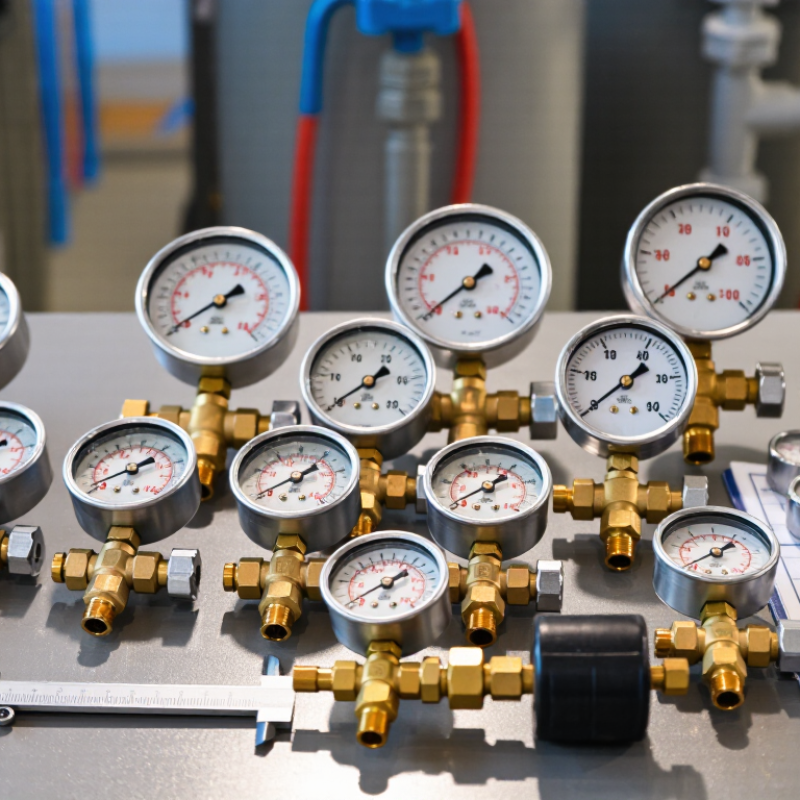
China manufactures several pressure gauge types for industrial, commercial, and laboratory applications. Bourdon tube gauges remain common for air, water, oil, and general process lines. Their curved tubes respond to pressure changes and move a pointer across a calibrated dial. They are simple, affordable, and easy to maintain.
Diaphragm pressure gauges suit corrosive, viscous, or contaminated media. A flexible diaphragm separates the process fluid from the measuring mechanism. This design helps protect internal parts, especially when the medium contains particles. Capsule gauges measure low pressures, such as clean air or gas in ventilation systems. Digital gauges provide clear readings and often include peak-pressure memory, selectable units, and battery indicators. They can reduce reading errors in dark workshops.
Differential pressure gauges compare pressure between two connection points. Technicians use them for filters, pumps, flow systems, and ventilation equipment. Sanitary gauges use polished wetted parts and hygienic connections for food or pharmaceutical environments. Temperature-compensated models can improve accuracy during changing conditions.
In practical purchasing, the pressure range matters as much as the gauge type. A gauge should not operate continuously near its maximum reading. I have seen this mistake shorten service life. Accuracy class, connection size, wetted materials, dial diameter, and calibration records also deserve careful review. Some product descriptions appear complete but omit ambient temperature limits. That detail can change performance. Independent calibration checks and sample testing provide stronger evidence than photographs or low prices.
What Are the Best Pressure Gauges from China? - Types of Pressure Gauges Manufactured in China
| Pressure Gauge Type | Measuring Principle | Typical Pressure Range | Typical Accuracy | Common Connection Sizes | Recommended Applications | Key Selection Advantages |
|---|---|---|---|---|---|---|
| Bourdon Tube Pressure Gauge | A curved elastic tube deforms under pressure and drives a mechanical pointer. | Approximately -1 to 1,600 bar, depending on tube design and model. | Typically ±0.5% to ±2.5% of full scale. | 1/8", 1/4", 3/8", or 1/2" BSP, NPT, or metric threads. | Water systems, compressed air, hydraulics, pneumatics, boilers, and general industrial equipment. | Simple construction, no power supply, broad availability, and good general-purpose performance. |
| Diaphragm Pressure Gauge | A flexible diaphragm moves in response to pressure and transfers displacement to the indication mechanism. | Approximately 0 to 25 bar for many standard designs; lower ranges are also available. | Typically ±1.0% to ±2.5% of full scale. | Commonly 1/4" or 1/2" process connections. | Low-pressure measurement, corrosive gases, viscous liquids, and media that may clog narrow passages. | Suitable for low pressures and can be manufactured with chemically resistant wetted materials. |
| Capsule Pressure Gauge | Two thin diaphragms are joined around their edges to form a capsule that expands or contracts with pressure. | Approximately 0 to 600 mbar for low-pressure measurement. | Typically ±1.0% to ±2.5% of full scale. | Usually 1/4" or 1/2" threaded connections. | Gas pressure, ventilation systems, air filters, clean rooms, and burner or combustion equipment. | High sensitivity at very low pressures and suitable for relatively clean, non-condensing gases. |
| Differential Pressure Gauge | Measures the difference between two pressure ports using a diaphragm, capsule, piston, or similar sensing element. | Approximately 0 to 600 bar differential pressure, depending on construction. | Typically ±1.0% to ±2.5% of full scale. | Often 1/8", 1/4", or 1/2" process connections. | Filter monitoring, flow measurement, liquid-level measurement, pumps, and process control. | Displays pressure loss or pressure difference directly without requiring two separate gauges. |
| Digital Pressure Gauge | A pressure sensor converts applied pressure into an electrical signal displayed on an electronic screen. | Commonly from -1 to 1,000 bar, with range depending on the sensor and application. | Typically ±0.25% to ±1.0% of full scale. | Commonly 1/4" or 1/2" BSP, NPT, or metric threads. | Calibration work, hydraulic testing, industrial maintenance, laboratories, and applications requiring easy data reading. | Clear numerical display, selectable units, peak-value functions, and reduced parallax error. |
| Electrical Contact Pressure Gauge | A mechanical pressure gauge incorporates electrical contacts that switch when the pointer reaches a preset value. | Approximately -1 to 1,000 bar, depending on the pressure element. | Typically ±1.0% to ±2.5% of full scale. | Usually 1/4" or 1/2" process connections. | Pump control, compressor protection, alarm systems, and automatic start-stop functions. | Combines local pressure indication with simple limit switching for control or alarm circuits. |
| Sanitary Pressure Gauge | Uses a diaphragm or other pressure element with hygienic process connections and cleanable surfaces. | Approximately 0 to 40 bar for many sanitary process applications. | Typically ±1.0% to ±2.5% of full scale. | Tri-clamp, hygienic threaded, or other sanitary connections. | Food and beverage processing, pharmaceutical production, biotechnology, and clean-process equipment. | Designed for cleanability, reduced contamination risk, and compatibility with hygienic installation practices. |
| Oxygen-Service Pressure Gauge | Usually uses a Bourdon tube or diaphragm sensing element prepared for oxygen-compatible service. | Commonly 0 to 400 bar, depending on the application and gauge design. | Typically ±1.0% to ±2.5% of full scale. | Commonly 1/4" or 1/2" connections. | Medical gas systems, welding equipment, oxygen distribution, and industrial gas installations. | Manufactured and cleaned to reduce the risk associated with oil, grease, and other combustible contaminants. |
| High-Temperature Pressure Gauge | A pressure-sensing mechanism is combined with a cooling element, siphon, or remote mounting arrangement. | Approximately 0 to 1,000 bar; the allowable process temperature depends on the configuration. | Typically ±1.0% to ±2.5% of full scale. | Commonly 1/4" or 1/2" process connections. | Steam lines, hot water systems, thermal oil equipment, and high-temperature industrial processes. | Helps protect the sensing element from excessive heat when correctly installed with suitable accessories. |
| Panel-Mount Pressure Gauge | May use a Bourdon tube, diaphragm, or digital sensor and is designed for installation through a control-panel opening. | Approximately -1 to 1,600 bar, depending on the selected sensing technology. | Typically ±0.5% to ±2.5% of full scale. | Rear-entry or lower-entry connections, commonly 1/8", 1/4", or 1/2". | Control cabinets, machinery panels, test benches, hydraulic power units, and OEM equipment. | Space-efficient installation and convenient front-panel visibility for operators. |
Note: The pressure ranges, accuracy classes, materials, connection standards, and temperature limits shown above are typical industry ranges rather than specifications for every gauge manufactured in China. Actual performance should be confirmed against the product datasheet, applicable standards, and the intended medium and operating conditions.